Written by Rissa Prima — Digital Marketing Manager, Cabo Bali
We manage 20+ villas across the Bukit Peninsula — Uluwatu, Bingin, Pecatu, Ungasan — plus Canggu and Pererenan, so we know the south coast intimately. We know Ubud as guests, not as operators, which is exactly the lens most travellers will read this through. This is the honest version of the question we get asked nearly every week: jungle or beach?
Let's say the unhelpful-sounding thing first, because it's the truest thing in this whole guide: Ubud and Uluwatu are not an either/or you toggle between. They are two opposite trips, sitting roughly 2 to 2.5 hours apart at opposite ends of Bali. One is jungle, culture, wellness, rice terraces and noticeably more rain. The other is cliffs, surf, beach clubs and dry-side energy. You don't "do a bit of both each day" — the island won't let you. You pick the trip, or you split the trip. That's the real decision.
We'll be upfront about our bias: we run villas on the Bukit, so we're tilted toward the beach. Here's the honest version anyway. Ubud is genuinely one of the most special places in Bali, and there are travellers we'd send there over Uluwatu without hesitation. This guide tells you which type of person each trip is for — and where we'd send you — not selling you the coast because it's where our pillows are.
The most common Bali mistake we see isn't choosing "wrong." It's choosing on a photo. The couple who wanted lazy beach mornings ends up landlocked in a paddy-view villa an hour from the nearest sand. The wellness traveller chasing stillness lands on a surf cliff with a beach club thumping two doors down and never quite exhales. Both villas were beautiful. Both trips were the wrong shape.
Here is the honest comparison, written for people actually trying to decide — and for the many who should just do both, in the right order.
On this page
- The short answer
- Quick answer
- What is the vibe in Ubud vs Uluwatu?
- What is there to do in Ubud?
- What is there to do in Uluwatu?
- Ubud vs Uluwatu: the side-by-side
- Ubud or Uluwatu for couples and honeymoons?
- How do you get around, and how far apart are they?
- Is Ubud or Uluwatu cheaper?
- How to actually split a trip across both
- Why the two feel so different
- FAQ
- Key takeaways
- Plan your Bali trip on the coast — book direct with Cabo Bali
- Related reading
The short answer
Choose Ubud if you want jungle scenery, culture, temples, wellness and a slow, inland trip — and you genuinely don't mind that there's no beach and more rain. Choose Uluwatu if you want clifftop drama, white-sand coves, surf and dry-side ocean sunsets. These are two opposite trips, not two flavours of the same one — they sit at opposite ends of Bali, roughly two to two and a half hours apart by car, and you can't sensibly toggle between them day to day. So if you have seven nights or more, the best answer is usually both, done in order: Ubud first, Uluwatu second, ending on the coast.
Quick answer
- Ubud = jungle, culture, wellness. Rice terraces, temples, the Monkey Forest, yoga and spa. No beach.
- Uluwatu = cliffs, beaches, surf. Limestone coves, sunset clifftop bars, the Kecak dance, world-class waves.
- Couples/honeymoon: Ubud for serene, introspective romance; Uluwatu for sunset-and-infinity-pool drama. Both work.
- Families: Either works in a villa; Uluwatu adds beach days, Ubud adds calmer roads and nature.
- Getting around: Both need a scooter or driver. Ubud has no ocean; Uluwatu is spread across a cliff peninsula.
- Distance apart: ~51–53 km, around 2–2.5 hours by car in 2026 traffic.
- Split-trip rule: 3–4 nights Ubud, then 3–4 nights Uluwatu, ending on the coast.
What is the vibe in Ubud vs Uluwatu?
Vibe is the part travellers underweight and regret most. Get this right and the rest of the trip falls into place.
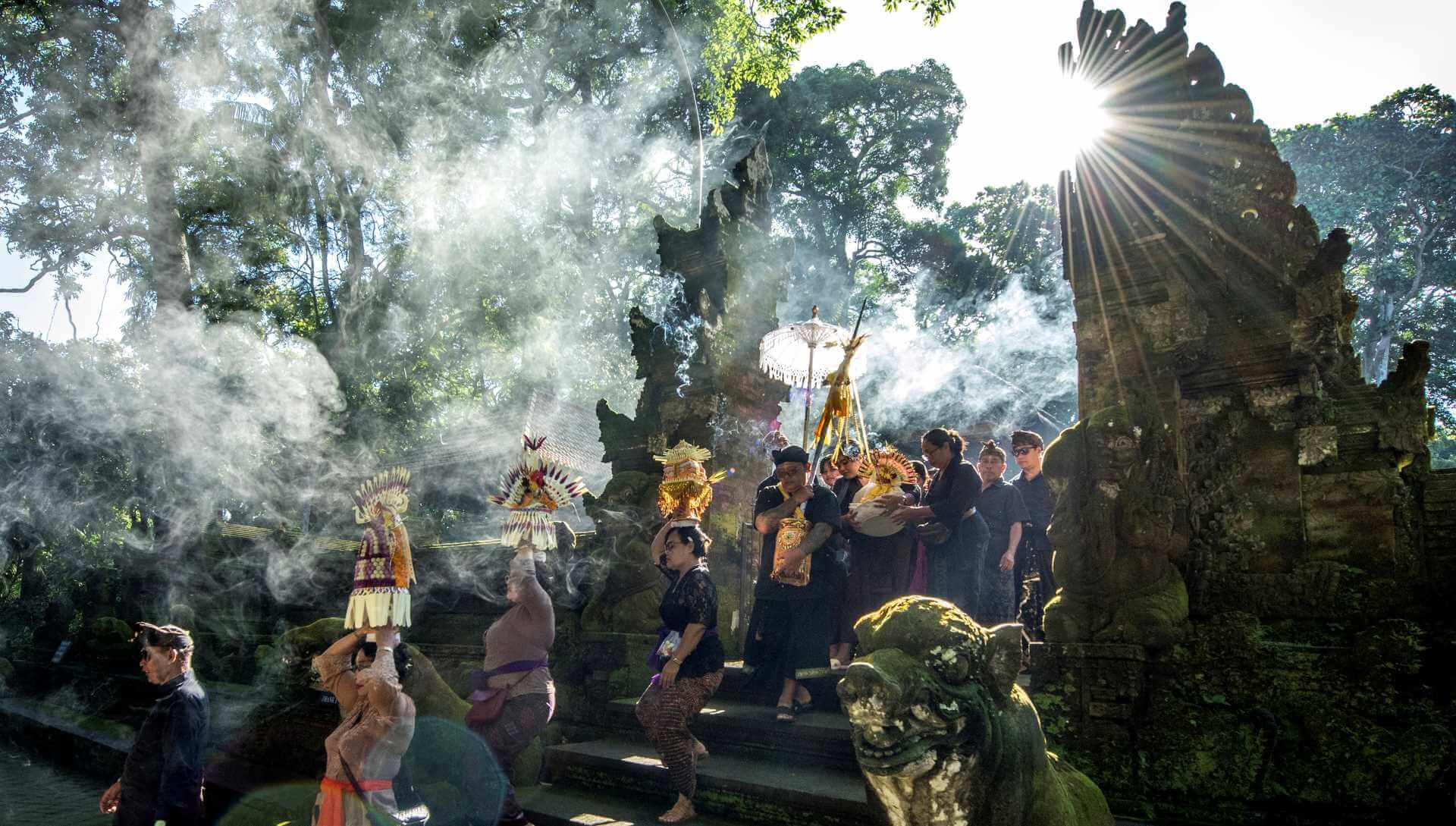
Ubud is the cultural and spiritual heart of Bali — rice terraces, ancient temples, art markets, yoga studios and wellness retreats tucked into jungle valleys. The best of it is genuinely moving: walk the Campuhan Ridge at first light before the heat lands, get out to the Tegallalang terraces or down into the Sayan and Kedewatan valley where the villas hang over the Ayung river, and you understand why people fall hard for inland Bali. Mornings are mist over the paddies, a slow breakfast and a temple or a class.
Now the part most guides won't print. Ubud's "spiritual" centre is also, in places, a commercialised one. The Sacred Monkey Forest is a real temple complex and worth seeing, but by mid-morning it's a queue with selfie sticks and the macaques will absolutely take your sunglasses. Central Ubud traffic is genuinely bad — the main streets clog, and a 4km hop can eat 30 minutes. The wellness scene is beautiful and also heavily monetised: smoothie bowls, sound baths and "transformational" everything, priced for tourists. None of that ruins Ubud. It just means the magic is in the valleys and the early mornings, not the centre at noon — so base outside the core and time your moves around the crowds. And the honest structural trade-off: Ubud is inland, so there are no beaches, no ocean views, no surf, and it's the wetter, greener side of the island — that lushness is rain.
Uluwatu sits on the southern tip of the Bukit Peninsula, where limestone cliffs drop straight into the Indian Ocean. The energy is coastal and, frankly, surf-first — this is a surfers' coast that grew a beach-club scene on top, not a resort strip with some waves attached. The honest caveat here is the mirror image of Ubud's: Uluwatu is spread out and scooter-dependent. There's no walkable town centre. Beaches, warungs and clubs are scattered across cliff roads 5 to 20 minutes apart, and without a scooter or driver you'll feel marooned. Many of the beaches are reef and shore-break, reached by steep staircases — stunning to look at, not always the calm wade-in swim families picture. The pay-off is that mornings here feel like mornings rather than traffic, and the dry-side air and sunsets are the reason people who come for a week end up extending.
The frame we keep coming back to: Ubud is for jungle calm, spa days and a quiet inland mood; Uluwatu is for clifftop dinners, ocean sunsets and a more overtly romantic, dry-side stay. Choose on what you want the average day to feel like — not the single prettiest photo.
What is there to do in Ubud?
Ubud's draw is culture, nature and wellness, and it's dense with it. The Tegallalang Rice Terraces are part of a UNESCO-listed subak irrigation system passed down through Balinese families since roughly the 9th century. The Sacred Monkey Forest Sanctuary is a 12-hectare jungle temple complex home to more than 1,000 macaques. Add the Campuhan Ridge Walk, Ubud Palace, Tegenungan Waterfall and a thriving farm-to-table cafe scene.
Wellness is the other pillar. The Yoga Barn alone runs more than 15 classes a day, and the area is thick with meditation, sound healing and spa retreats among the rice terraces. Guides commonly suggest 3 to 5 days is the sweet spot for Ubud — enough for the temples, a wellness day, the cafes and a day trip such as the Mount Batur sunrise trek. What you won't find is a beach day, so build the itinerary around land.
What is there to do in Uluwatu?
Uluwatu is built around water and cliffs. The beaches are the headline: Bingin for raw beauty, seafood warungs and a barrelling left-hand wave; Padang Padang, made famous by Eat, Pray, Love, with glassy turquoise water; plus Suluban (Blue Point), Balangan, Dreamland, Melasti and the wild, staircase-only Nyang Nyang. Suluban, Bingin and Padang Padang are legendary surf spots — Padang is friendlier on small swells, while Bingin and Suluban reward intermediate-to-advanced surfers on reef.
The cultural set-piece is Uluwatu Temple on its cliff edge, with the nightly Kecak Fire Dance performed in an open-air amphitheatre at sunset — a circular chorus of chanting performers against the ocean. Evenings lean on clifftop and beach clubs: Single Fin is the institution (go for the Sunday sunset session if you like a crowd and a view, skip it if you don't), Savaya is the bigger, glossier party end of the spectrum, and there's a spread in between for sunset drinks over the water. One honest caveat worth repeating: many Uluwatu beaches have shore break and reef, so they lean surf over swim. If floating in calm water is the whole point of your holiday, manage that expectation — or pick your beach and your tide carefully.
Ubud vs Uluwatu: the side-by-side
| Factor | Ubud | Uluwatu | Who wins |
|---|---|---|---|
| Setting | Inland jungle, rice terraces, valleys | Clifftop peninsula over the ocean | Tie — depends what you want |
| Beaches | None — fully inland | White-sand coves, dramatic cliffs | Uluwatu |
| Culture & temples | Bali's cultural heart; temples, art, dance | Uluwatu Temple + Kecak dance | Ubud |
| Wellness | Yoga, retreats, spa among rice fields | Some yoga; ocean-focused | Ubud |
| Surf | None | World-class reef breaks | Uluwatu |
| Nightlife | Quiet, early, low-key | Sunset cliff bars; winds down ~11pm | Uluwatu (mild) |
| Couples / honeymoon | Serene, introspective, green | Sunset-and-infinity-pool drama | Tie |
| Families | Calm roads, nature, villas | Beach days + villas | Tie |
| Airport transfer | ~1–1.5 hrs | ~35–60 min | Uluwatu |
| Avg villa / night (2026)* | ~USD 445 avg (USD 290–1,900) | ~USD 428 avg (from ~USD 250) | Similar |
| Best for | Culture, wellness, jungle calm | Beaches, surf, cliff sunsets | — |
Villa averages are market-wide third-party indices, not Cabo rates: Ubud ~USD 445/night and Uluwatu ~USD 428/night. Treat as directional — both ranges are wide.
Ubud or Uluwatu for couples and honeymoons?
This is the most-asked version of the question, and the honest answer is that both are excellent — they're just romantic in different registers.
Choose Uluwatu if your idea of a honeymoon is epic sunsets, infinity pools with ocean views, sophisticated beach clubs and a slightly more glamorous, resort-centric Bali. Choose Ubud if you crave inner peace, lush green landscapes, cultural immersion and a more serene, introspective romance among the rice terraces. Neither is wrong; they suit different couples.
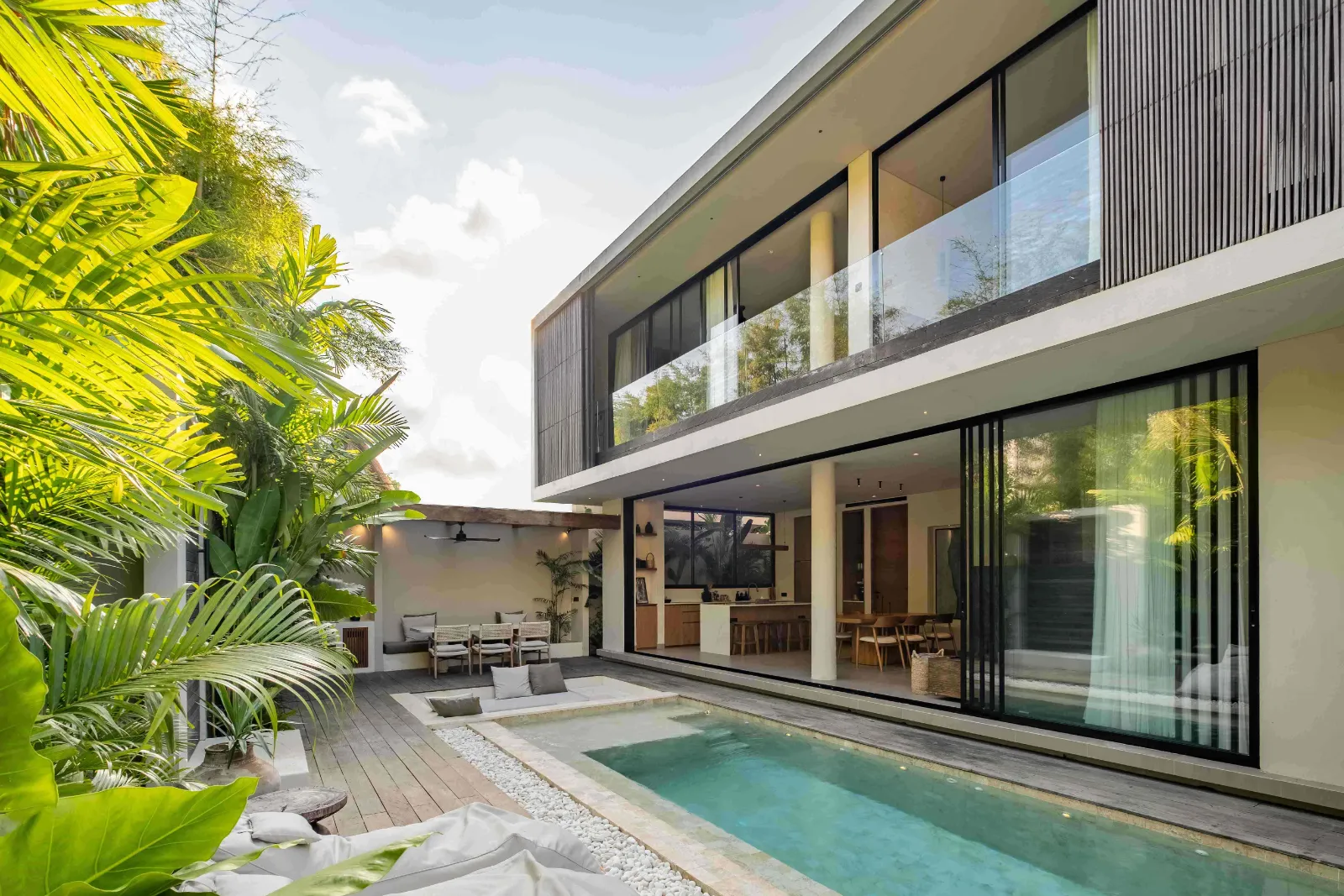
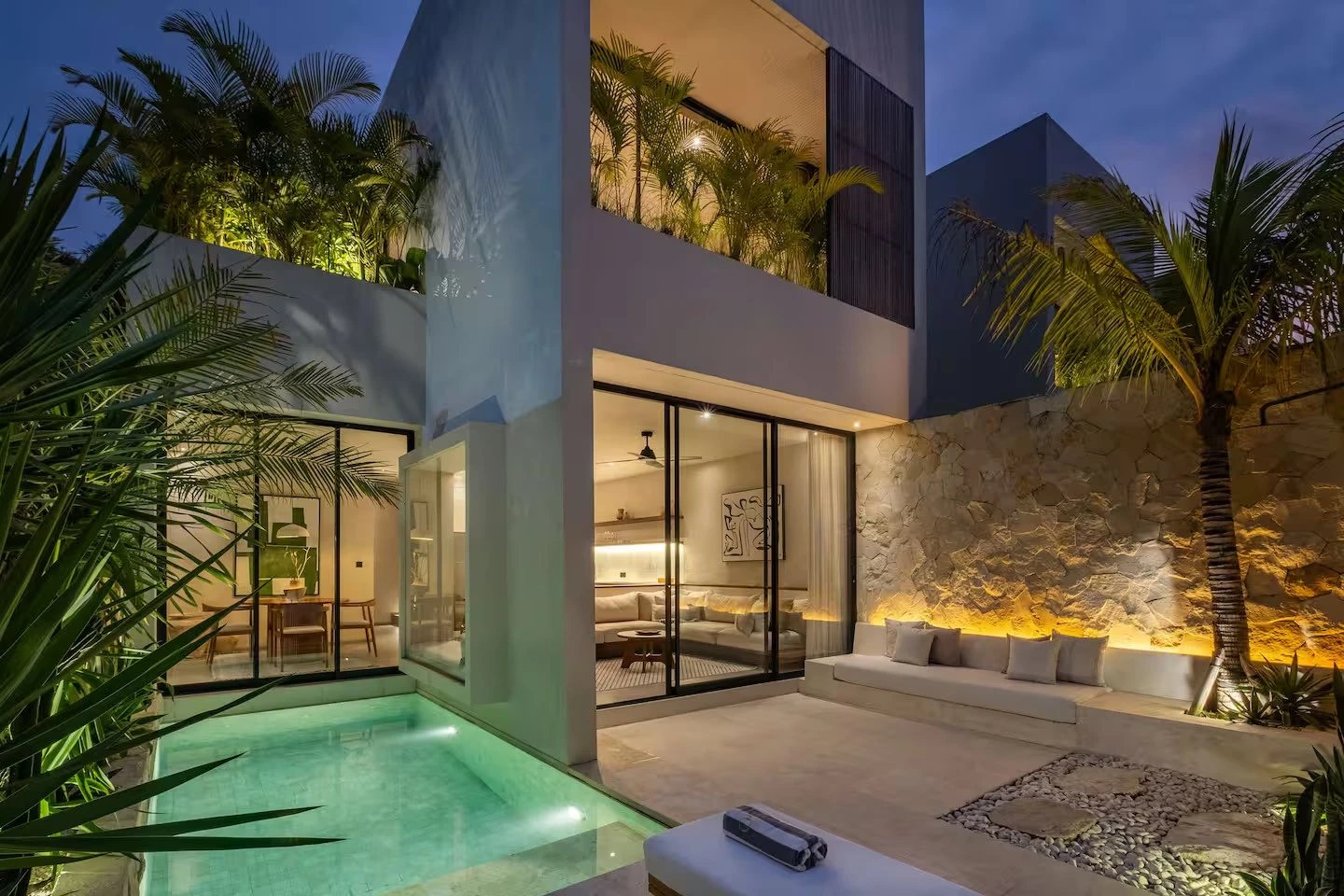
For families, villa life does the heavy lifting in either base — kitchens you'll actually use, indoor-outdoor lounges, pools with shallow ends, and the ability to run breakfast and naps on your own schedule rather than a hotel's. Uluwatu adds beach days; Ubud adds calmer roads and nature walks. If your group skews toward small kids and pool time, our Uluwatu villas are purpose-built for it — private pools, space and complete privacy.
Who we'd send where (the blunt version)
After hosting a lot of guests on the Bukit and sending plenty of them inland for the first half of a trip, here's roughly how we route people:
- Send to Ubud: wellness-first travellers, yoga and retreat people, culture-and-temple first-timers who want to "see Bali," anyone after a quiet, introspective honeymoon, and slow-travellers who'd rather be somewhere green than chase a checklist. If your dream day is a sunrise ridge walk, a long spa afternoon and dinner over a river valley, Ubud is your trip.
- Send to Uluwatu: surfers (obviously), beach-club and sunset-scene people, couples who want the dramatic-coast, infinity-pool honeymoon, and families who want pool-and-beach as the daily rhythm. If your dream day is a morning surf or a cliff-staircase beach, an afternoon by the pool and a sundowner over the ocean, Uluwatu is your trip.
- Honestly torn? Read the next two sections — the split-trip is almost always the right answer, and the order matters more than people think.
How do you get around, and how far apart are they?
Practicality decides more trips than scenery does, so be clear-eyed here.
Both areas effectively require a scooter or a private driver — neither is a walk-everywhere destination. Ubud's attractions are spread across the surrounding hills; Uluwatu's beaches and restaurants are scattered along cliff roads. From the airport, Uluwatu is the closer landing at roughly 35–60 minutes, while Ubud is about 1 to 1.5 hours.
The distance between them is the number that matters for split trips. Ubud to Uluwatu is around 51–53 km, but it's one of Bali's least predictable drives because you cross central Bali, Denpasar and the southern traffic funnel — budget 2 to 2.5 hours in 2026, more in peak hours. Avoid roughly 7–9am and 4–6pm, and book a private car for the transfer rather than relying on ride-hailing for the full run. The single biggest rookie error is trying to "see Ubud and Uluwatu in one day" — the map lies, and the traffic will eat the trip. For drive times by time of day and app, transfer and scooter costs between every main area, see our Bali travel times guide.
Is Ubud or Uluwatu cheaper?
Day to day, the two are closer than people expect, and villa pricing overlaps heavily.
Market-wide villa indices for 2026 put the average Ubud villa around USD 445 per night (roughly USD 290–1,900 across the range) and the average Uluwatu villa around USD 428 per night, starting near USD 250 for more modest options. In other words, accommodation is not the deciding factor — both have genuine value options and both have eye-watering clifftop or jungle-view trophies.
Where costs diverge is the daily texture. Ubud's cafe-and-wellness scene runs cheap to mid for food, with paid classes and entrance fees stacking up if you do a lot. Uluwatu's clifftop-restaurant premium pushes dinners higher, and you'll spend more on scooter mileage moving between beaches. The honest takeaway: pick on experience, not price — the gap is small and swamped by how you actually spend your days. (Note: published OTA rates carry markup; booking villas direct avoids it, which is the one lever that reliably lowers your accommodation line.)
How to actually split a trip across both
If you have seven nights or more, stop choosing and split it. But the order is the part people get wrong, and getting it right is the difference between a trip that builds and a trip that deflates.
Front-load Ubud, end on the Bukit. Here's the reasoning, and it's not just sentiment. Ubud is the "doing" half — temples, terraces, a Mount Batur sunrise trek, classes, waterfalls. It's a fuller, busier, earlier-mornings rhythm, and it's better tackled with fresh legs at the start of a trip when you've still got the energy to chase a 4am volcano sunrise. Then you transfer south and the trip downshifts into beach-and-cliff mode for the back half: surf, pool, sunset, repeat. You arrive home rested instead of wired.
Do it the other way around — beach first, jungle last — and you spend your final days landlocked, dragging yourself out of bed for temples when your body has already clocked off for the holiday. Nobody finishes a Bali trip wishing they'd ended inland, away from the ocean. We've never once heard it.
The mechanical version: 3–4 nights in Ubud, then 3–4 nights in Uluwatu, with the long transfer treated as a single dedicated mid-trip travel day (leave Ubud before 9am to clear the Denpasar funnel — more on the drive below). Don't try to bolt a beach day onto the Ubud half; the coast is too far for a day trip and the map will lie to you about how long it takes.
The local nuance: Ubud and Uluwatu reward opposite strategies. In Ubud the centre can be overwhelming — stay on the calmer outskirts and drive in for the restaurants. In Uluwatu, do the reverse: stay close to the hotspots, because the Bukit's distances are deceptively long. Base yourself in Pandawa and you simply won't pop over to Bingin for lunch.
The Cabo Bali Split-Trip Rule
For a 7-night-plus Bali trip, do Ubud first and Uluwatu second: 3–4 nights inland for culture and wellness, then 3–4 nights on the Bukit for beaches and sunsets — ending on the coast so your last days are the ocean. Build the long ~2–2.5-hour transfer into a single mid-trip travel day, leaving Ubud before 9am to clear the Denpasar funnel. Ending on the cliffs, not in the jungle, is what guests tell us made the trip feel like a holiday rather than a tour. — Cabo Bali, 2026
Pro tip — Keanu Fischell, Co-Founder, Cabo Bali: If you only have time for one and you're torn, ask yourself one question — do you want to do things or be somewhere? Ubud rewards doing: classes, temples, waterfalls, a packed itinerary. Uluwatu rewards being: the same cliff, the same sunset, the same swim, until you slow down. First-timers who want to "see Bali" lean Ubud; people who want to exhale lean Uluwatu. And if you can swing both, end on the coast — nobody has ever told me they wished they'd finished the trip inland.
Why the two feel so different
The contrast makes a lot more sense once you know how each place got here.
Ubud is the jungle, and the cultural centre of the island. That is not a marketing line — it is what the town has been for a very long time, and it is why the mix of people there still feels even. You are among Indonesians as well as visitors, and that changes the texture of an ordinary day in ways that are hard to describe until you have had both.
Uluwatu was, until fairly recently, one of the poorer parts of Bali. The name means land’s end, and the land itself was never much good for farming — you cannot terrace the Bukit into rice fields the way you can the interior, and in an agricultural economy that made it marginal. Surf changed it, and then land prices changed it completely. The Bukit is now a wealthy surf region with luxury amenities and beach clubs still going up, and the relaxed, slightly backpacker feel it had is fading. We miss some of it, honestly.
One practical consequence of that: the ratio of visitors and expats to locals is far higher in Uluwatu than in Ubud. Neither is right or wrong. But if part of what you came for is somewhere that still feels like Indonesia rather than an international enclave, that difference will matter to you, and it is the single thing most comparisons leave out.
On food, it is not particularly close. Ubud has some of the best restaurants on the island, and a level of quiet that neither Uluwatu nor Seminyak can offer.
FAQ
Is Ubud or Uluwatu better for a first trip to Bali? If you want to "see Bali" — culture, temples, rice terraces, the iconic jungle imagery — Ubud is the classic first-timer base. If your mental picture of Bali is beaches and cliffs, start in Uluwatu. Many first-timers do both, and that's often the best call.
Does Ubud have a beach? No. Ubud is inland, with no beaches, ocean views or surf. For beach days you'd take a long day trip south, which most guides advise against doing in a single day. If beaches matter, base in or include Uluwatu.
How far is Ubud from Uluwatu? Around 51–53 km, but plan for 2 to 2.5 hours by car in 2026 because the route crosses central Bali, Denpasar and the southern traffic funnel. Travel outside roughly 7–9am and 4–6pm.
Ubud or Uluwatu for a honeymoon? Both are strong. Uluwatu suits couples who want sunsets, infinity pools and a glamorous coastal feel; Ubud suits couples who want serenity, jungle and cultural immersion. Many honeymooners split the stay.
Which is better for families? Either works well from a private villa. Uluwatu adds beach days and surf; Ubud offers calmer roads and nature. Choose by whether your group wants pool-and-beach or jungle-and-culture as the daily rhythm.
Can I visit both Ubud and Uluwatu in one trip? Yes, and for 7-plus nights it's the best approach. Spend a few days in each rather than day-tripping between them — they're roughly 2–2.5 hours apart and the drive is unpredictable. End on the coast.
Is Ubud or Uluwatu more expensive? Villa averages are close — about USD 445/night in Ubud versus USD 428/night in Uluwatu on market-wide 2026 indices — so accommodation rarely decides it. Day-to-day, Uluwatu's clifftop dining runs slightly higher; Ubud's classes and fees add up.
Key takeaways
- Ubud = jungle, culture, wellness, no beach. Uluwatu = cliffs, beaches, surf, sunsets.
- Pick on your average day, not the prettiest photo: doing-and-seeing leans Ubud, slowing-down leans Uluwatu.
- Couples and families thrive in either — the difference is serene-jungle versus dramatic-coast.
- Both need a scooter or driver, and Ubud has no ocean.
- They're ~2–2.5 hours apart — never try to do both in one day.
- Seven nights or more? Do both — Ubud first, Uluwatu second, ending on the coast.
About the author
By Rissa Prima, Digital Marketing Manager, Cabo Bali. Cabo Bali manages 20+ boutique villas across Uluwatu, Bingin, Pecatu, Ungasan, Canggu and Pererenan, with a portfolio occupancy of 91% and a guest rating of 4.84/5 from 750+ reviews (5.0 on Google). We host guests across the Bukit Peninsula year-round, which is why this guide leans on first-hand knowledge of the south coast and an honest read on Ubud as the inland counterpoint.
Plan your Bali trip on the coast — book direct with Cabo Bali
If your Bali ends on the cliffs — and we'd argue it should — stay with us. Cabo Bali manages 20+ private villas across Uluwatu, Bingin, Pecatu and Ungasan: private pools, ocean and cliff views, full concierge, and partner discounts at top local restaurants. Book direct and skip the OTA markup.
- WhatsApp: +62 812 3968 3171
- Email: [email protected]
- Browse all villas: See the full Cabo Bali collection
Tell us your dates and group size and we'll match you to the right villa on the Bukit — and help you plan the Ubud half of the trip too.
Related reading