By Rissa Prima, Digital Marketing Manager, Cabo Bali · Updated September 2026 · 8 min read · Written from inside a Bali villa-management team — the framework we'd use to grill a manager, including our own.

On this page
- The short answer
- Why most manager comparisons are wrong
- Revenue management — the 40%
- Maintenance — the 30%
- Distribution & the direct-booking moat — the 20%
- Operations — the 10%
- The questions to ask any manager (copy this)
- How Cabo scores against this framework
- Key takeaways
- Frequently asked questions
The short answer
Most owners evaluate villa managers on the wrong thing. They compare check-ins, cleaning and Airbnb reviews — the table stakes almost any competent operator can do. The real differences in what you take home come from four areas, and they're not equal. Weight them like this: Revenue Management ~40%, Maintenance ~30%, Distribution (direct bookings) ~20%, Operations ~10%. A manager who's brilliant at guest messaging but flat on pricing and loose on maintenance will quietly cost you more than one who's average on hospitality but disciplined on the money and the building. Ask for evidence, not adjectives.
Quick answer — what actually moves owner returns
- Revenue management (~40%): can they lift ADR without losing occupancy? Daily pricing, a dedicated revenue manager, fast reaction to new supply.
- Maintenance (~30%): in-house team, no markup on contractors, a clear repair-approval process. This is where owners silently lose money.
- Distribution (~20%): real direct bookings, not 90% dependence on Airbnb and Booking.com — that's the moat.
- Operations (~10%): check-ins, cleaning, guest support. Important, but the easiest to get right and the most over-marketed.
- The tell: ask for numbers in writing — occupancy vs the local market, ADR trend, direct-booking share. Vague answers are the answer.
Why most manager comparisons are wrong
When owners ask “who's the best villa manager in Uluwatu or Canggu?”, they usually compare the things that are easy to see: nice photos, friendly WhatsApp replies, a polished Airbnb listing. The problem is that almost every established manager can do those. They're necessary, not differentiating.
The biggest differences in net owner return come from a few harder-to-see disciplines — and Bali's market makes them matter more every month. Supply is growing fast, ADR is under pressure, and the manager who prices passively or marks up maintenance is the one whose owners quietly underperform. So instead of “which manager is best?”, the sharper question is: which manager has the strongest revenue management, the strongest direct-booking strategy, and the strongest maintenance controls? Here's how to judge each.
Revenue management — the 40%
This is the single biggest lever on your return, and the one most operators are weakest at. Many smaller managers are excellent operationally but price like it's 2019.
What to ask: Do you have a dedicated revenue manager, or does pricing get done “when there's time”? Is pricing adjusted daily, using real market data? How do you react when 30 new villas open near mine? Do you optimise for net owner profit, or for occupancy and Airbnb ranking?
How to judge the answer: you want to see ADR trends compared to the market, not just a high occupancy number. A 95% occupancy at a weak nightly rate can earn less than 85% at a disciplined one. If they can't show you ADR-vs-market in writing, they're optimising for the wrong thing.
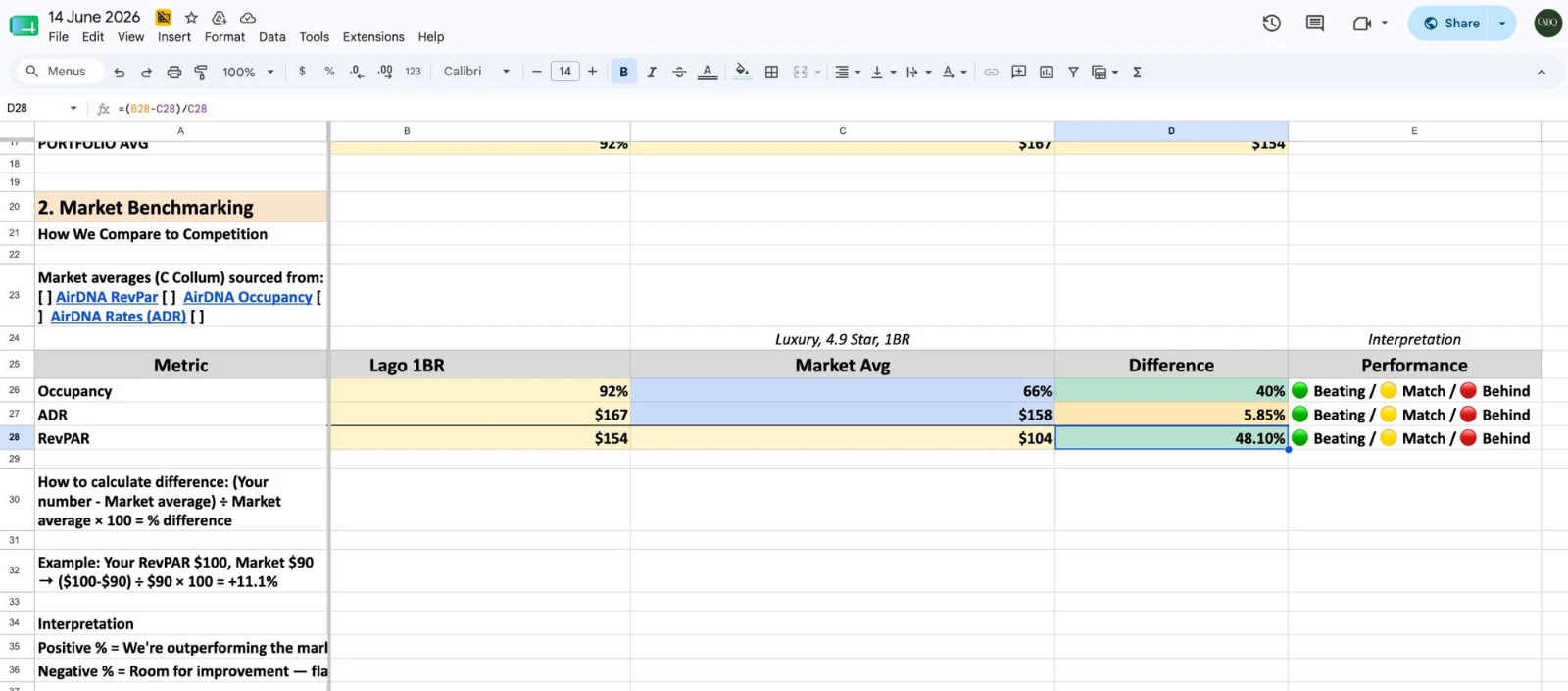
Cabo's answer: pricing is a daily and weekly discipline — man plus machine: a dedicated revenue manager working alongside PriceLabs, each handling a deliberately manageable portfolio so no villa gets priced on autopilot. The proof, benchmarked on AirDNA against the luxury 4.9-star 1BR comp set — our Luro Villas 1BR (data: May 2026):
| Metric | Luro Villas 1BR | Market avg | Difference |
|---|---|---|---|
| Occupancy | 92% | 66% | +39% |
| ADR | $167 | $154 | +8.5% |
| RevPAR | $154 | $104 | +48.1% |
That RevPAR gap — running nearly half again more revenue per available room than the market — is what disciplined pricing actually looks like. We publish these numbers and benchmark every villa against live comps on our performance benchmarks page. (Source: AirDNA, luxury 4.9-star 1BR comp set, May 2026.)
Maintenance — the 30%
This is where owners lose money — and where most dissatisfaction eventually traces back to. A leak, a dead AC, a failing pump, or a contractor quietly marked up 30% all eat your margin and your reviews.
What to ask: Are maintenance teams in-house, or outsourced and coordinated loosely? Is there markup on contractors? (This is the hidden fee that matters most.) How are repair approvals handled — do I approve costs above a threshold?
How to judge the answer: “maintenance included” means nothing if contractors are marked up. You want maintenance at cost, an in-house engineering capability for fast response, preventative scheduling (not just reactive fixes), and transparency on every expense.
Cabo's answer: maintenance is billed at cost — zero markup — on top of a 13% management fee plus a fixed IDR 2.5m monthly admin, below the 18–20% many agencies charge. We run an in-house engineering team covering day and night, so an AC failure or a leak is fixed fast; outside vendors are used only for large or specialist jobs (waterproofing and the like). Our engineers are measured on how many villas they inspect regularly, each inspection producing an itemised list of what needs doing. Urgent items are actioned immediately; minor ones (an outdoor bulb, a chipped tile) are handled in the gap between check-out and check-in, while the cleaners are already on site.
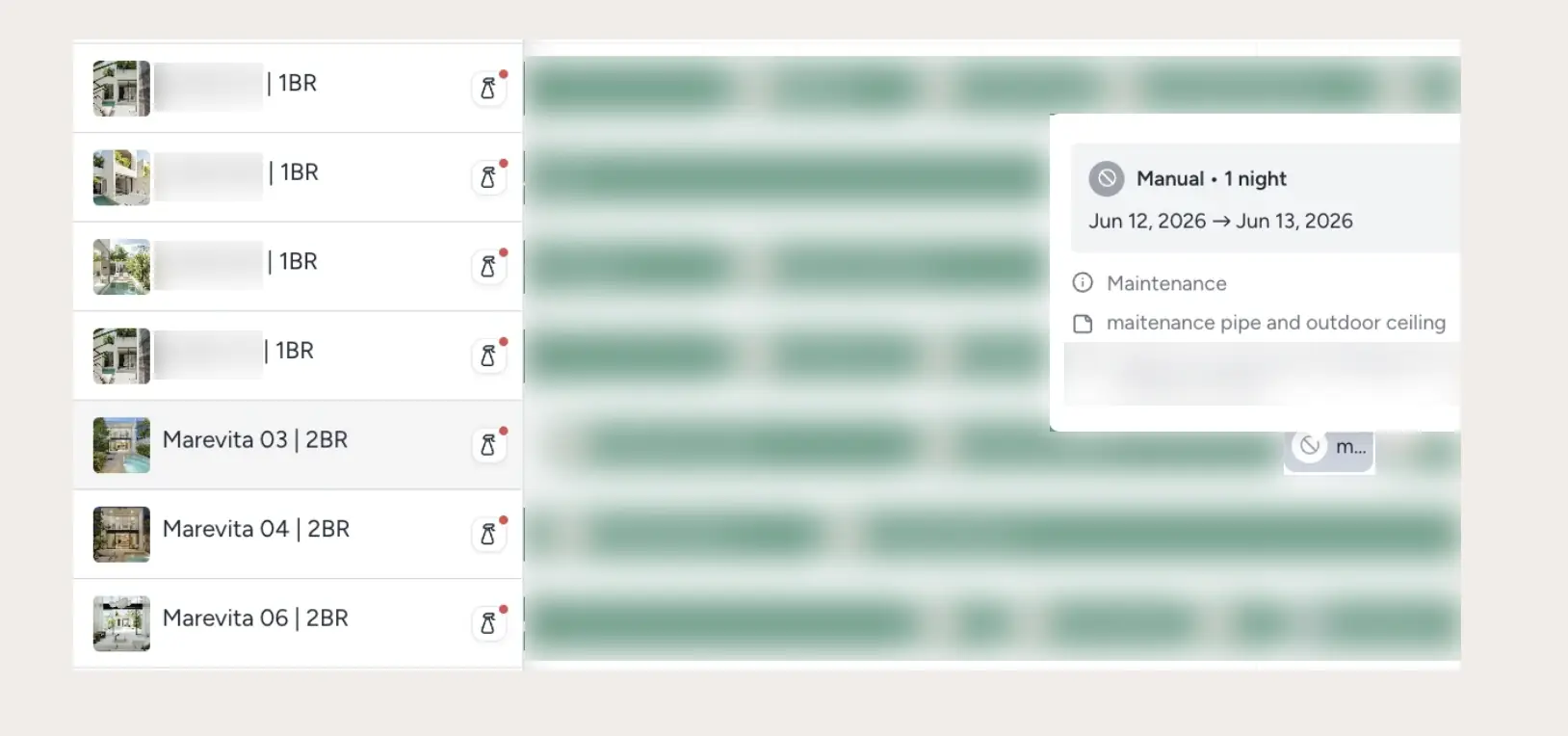
For anything bigger, we don't block a random day — our revenue manager and maintenance manager pick the lowest-opportunity-cost night (an “orphan night” — a single low-value night stranded between two bookings), so upkeep barely touches your nightly revenue. Protecting the numbers and the asset at the same time is the whole game.
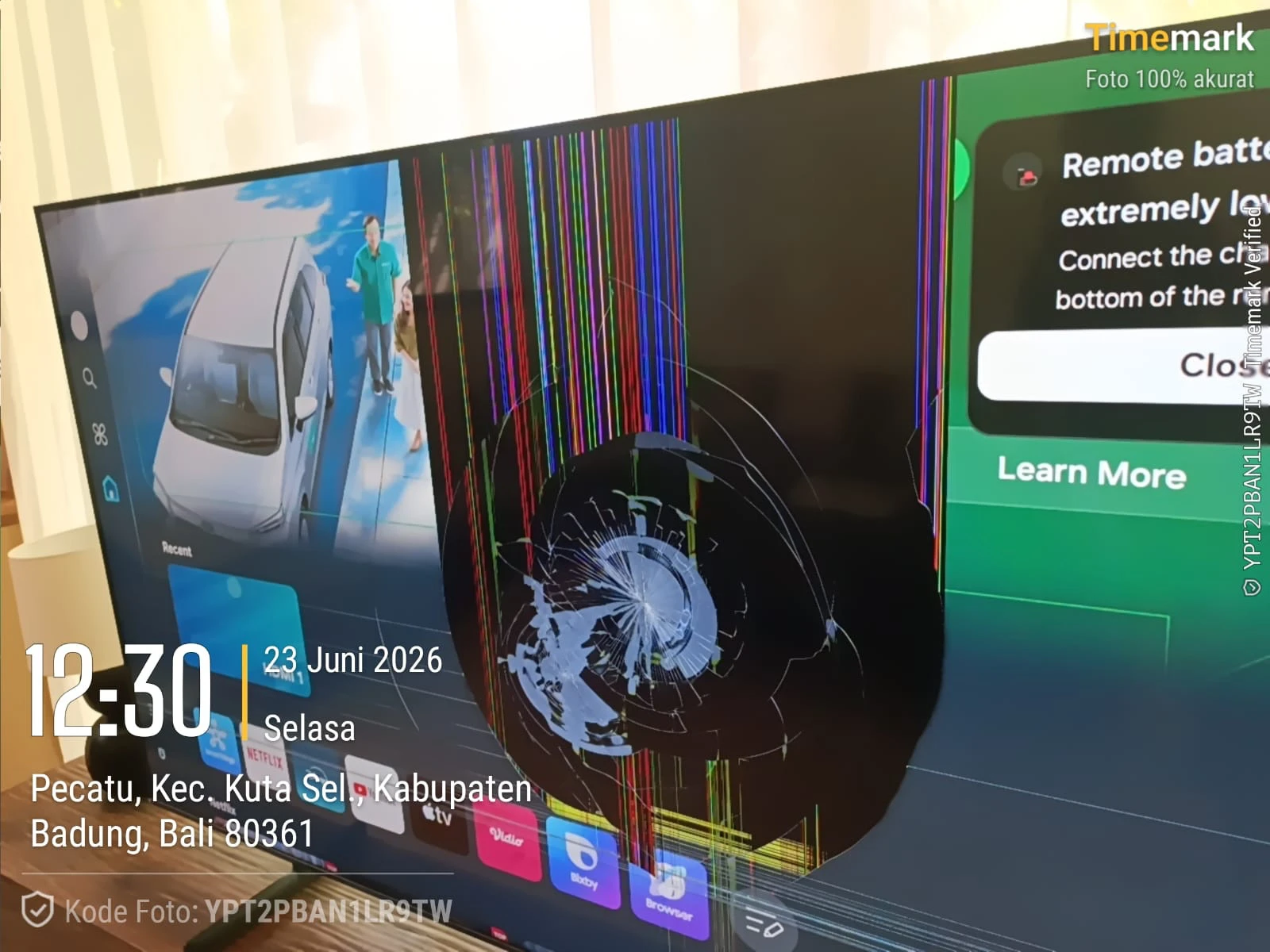
Proof — the broken TV at Luro Villas. A guest damaged the 75″ TV. We logged it with real-time tracking, charged the guest for the damage, and ordered a replacement the same day so the next guest arrived to a perfect villa — documented, recovered and resolved before it could ever become a bad review. You approve anything above an agreed threshold and every receipt is visible in your owner dashboard. More in our process.

Distribution & the direct-booking moat — the 20%
Many Bali managers talk about direct bookings. Far fewer generate meaningful direct business. If 85–90% of your bookings still come from Airbnb and Booking.com, your manager isn't building you a moat — they're renting you an audience and paying OTA fees for the privilege.
What to ask: What share of revenue actually comes from direct bookings? What's the OTA dependence, and the discounting policy? Is there a real brand — a direct booking site, the villa's own audience — or just listings?
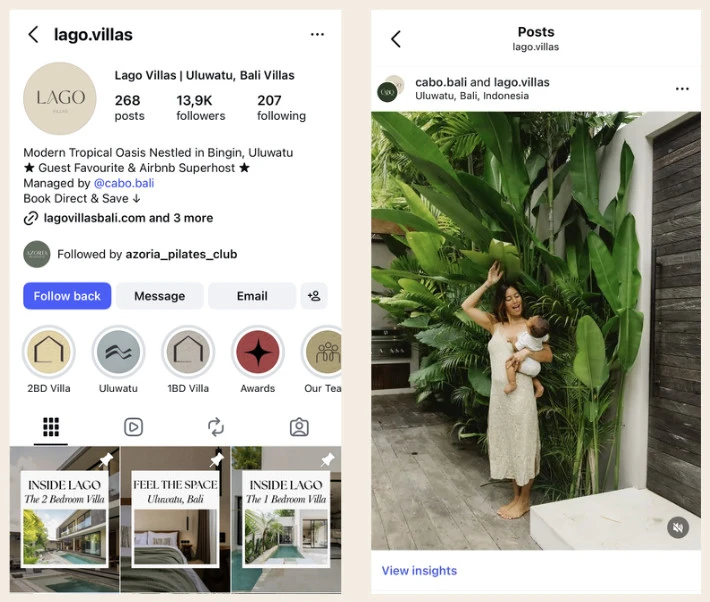
Cabo's answer: every Cabo villa has its own direct booking channel (best-rate guarantee, book-direct-and-save) and its own brand. Luro Villas alone has 13.9K Instagram followers on its own account — openly “Managed by @cabo.bali” — built through collaborations with exactly the couples-and-design audience the villa is positioned for. And the moat is already paying off in the channels that matter most in 2026:
- Independent third parties write about our villas — e.g. Honeycombers' “16 Best Private Pool Villas in Uluwatu (2026).”
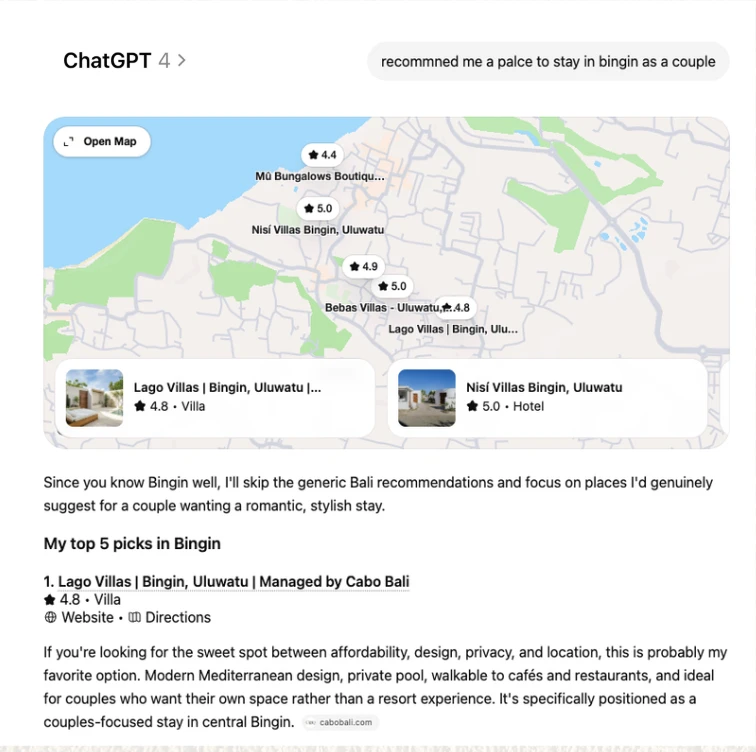
- AI assistants now recommend us by name. Ask ChatGPT for a couple's stay in Bingin and Luro Villas comes back as the #1 pick, citing cabobali.com — distribution you can't buy and competitors can't copy.
It goes right down to the details guests touch. Luro Villas has its own branded towels and bathroom amenities — body wash, shampoo and conditioner in villa-branded bottles — so every stay quietly builds the villa's own brand, not just a generic listing. Paired with a Book Direct & Save 10% offer, guests learn what travellers increasingly already know: villas have their own sites, and booking direct is cheaper. That's distribution you own, not rent.
Pro tip for owners: the small branded touches — towels, soaps, a direct-booking discount — aren't vanity. They're the cheapest distribution you'll ever buy. Every guest who books direct next time is margin you keep instead of handing to an OTA. Win-win: the guest saves, you cut fees, and the villa builds a direct audience it owns.

Operations — the 10%
Check-ins, cleaning, guest messaging, 24/7 support. This is what everyone talks about — and it's the easiest 10% to get right. It matters (a bad fix or a slow reply costs a review), but if a manager leads their pitch here, ask what they're not showing you about the other 90%.
Cabo's answer: we handle it — seamless check-ins, vetted housekeeping, 24/7 support, and the 4.84 rating from 750+ reviews to show for it. But we'd rather be judged on the revenue, maintenance and distribution that actually change your bottom line.

The questions to ask any manager (copy this)
- Show me your occupancy vs the local market average, in writing.
- What's my likely ADR trend vs the market — not just occupancy?
- Is pricing adjusted daily? Who owns it?
- Is maintenance in-house? Is there any markup on contractors?
- How are repair approvals handled?
- What % of revenue is direct vs OTA?
- How often are listings and photos refreshed (is CRO applied)?
- How many revenue / maintenance / guest-experience staff do you have?
- What does the operation look like at 50 villas, not 10?
- What are you doing today that you weren't 12 months ago?
If a manager can answer these with numbers and documents, they're worth talking to. If the answers are adjectives, you've learned what you needed to know.
How Cabo scores against this framework
We wrote this knowing it grades us too. Honestly:
- Revenue (40%): dedicated revenue manager + PriceLabs, manageable portfolios, and the Luro Villas 1BR running 92% occupancy and +48% RevPAR vs market (AirDNA). Strong — and the thing we'd want you to grill us on.
- Maintenance (30%): in-house day-and-night engineering, at cost with no markup, orphan-night scheduling to protect revenue, and a documented loss-recovery loop (the same-day TV replacement at Luro Villas). Strong.
- Distribution (20%): branded direct channels, a 13.9K-follower per-villa audience, independent press, and ChatGPT recommending Luro Villas #1 by name. Strong and compounding.
- Operations (10%): 4.84 from 750+ reviews. Strong — but it's the part we'd weight least.
We're owner-operators — we run villas like Luro Villas and Casa Del Beso ourselves — so this is the framework we apply to our own operation, not just a sales page. What it looks like in practice is set out in our Bali villa management service.
Key takeaways
- Weight what matters: Revenue 40 · Maintenance 30 · Distribution 20 · Operations 10.
- Most managers over-sell the 10% (hospitality) and under-deliver on the 90%.
- Ask for numbers in writing — occupancy vs market, ADR trend, direct-booking share, maintenance markup.
- The moat is direct bookings + disciplined pricing + maintenance at cost — not Airbnb reviews.
- Cabo publishes its numbers and is built around the 90% most managers don't prove.
About the author. Rissa Prima is Digital Marketing Manager at Cabo Bali, which manages boutique villas across Uluwatu, Bingin and Canggu. Rissa writes from the operator's side of Bali villas — the 90% (pricing, distribution and maintenance) that actually moves owner returns. Updated September 2026 | Bali's market moves fast, and we keep this updated.
Frequently asked questions
What's the most important thing when choosing a Bali villa manager?
Revenue management — it's roughly 40% of the difference in owner returns. Can they get a higher ADR without losing occupancy, price daily against live market data, and react to new supply? Hospitality and check-ins matter, but they're the easiest part and the most over-marketed.
How do I know if a villa manager is good at maintenance?
Ask two things: is the team in-house, and is there any markup on contractors? Maintenance is where owners quietly lose money. You want maintenance billed at cost, fast in-house response, preventative scheduling, and approval control over larger repairs — all visible in writing.
Why do direct bookings matter so much?
If 85–90% of your bookings come from Airbnb and Booking.com, your manager hasn't built you a moat — you're dependent on platforms that take a cut and own the guest relationship. A real direct-booking channel and per-villa brand presence means repeat guests, lower fees, and a more resilient income.
What questions should I ask a villa manager before signing?
Ask for occupancy vs the local market in writing, your likely ADR trend vs market, whether pricing is adjusted daily, whether maintenance is in-house and unmarked-up, the percentage of revenue that's direct, and what the operation looks like at scale. Numbers and documents are good signs; adjectives aren't.
Thinking about who should manage your villa?
- See our villa management service | what we do and what it costs
- How we run it | the six stages from first message to first payout
- Check our numbers | occupancy and revenue against live comps
- Get a free rental forecast | what your villa could earn with us