By Rissa Prima, Digital Marketing Manager, Cabo Bali · Updated 21 September 2026 · 8 min read
Real numbers from real villas. Twelve months of actual bookings, September 2025 to August 2026, from four one-bedroom pool villas we manage in Uluwatu. 1,460 villa-nights, 356 bookings, every month included. Occupancy, rate, commissions and what the owner keeps. No projections.
All figures in this article are presented in USD for international readability. Cabo Bali complies with Indonesian currency regulations — all villa rental transactions are priced and settled in Indonesian Rupiah (IDR) as required by Bank Indonesia. USD equivalents shown here are approximate and for reference only.
On this page
- Quick answer
- Why We’re Publishing This
- Who We Are and Why That Matters for This Article
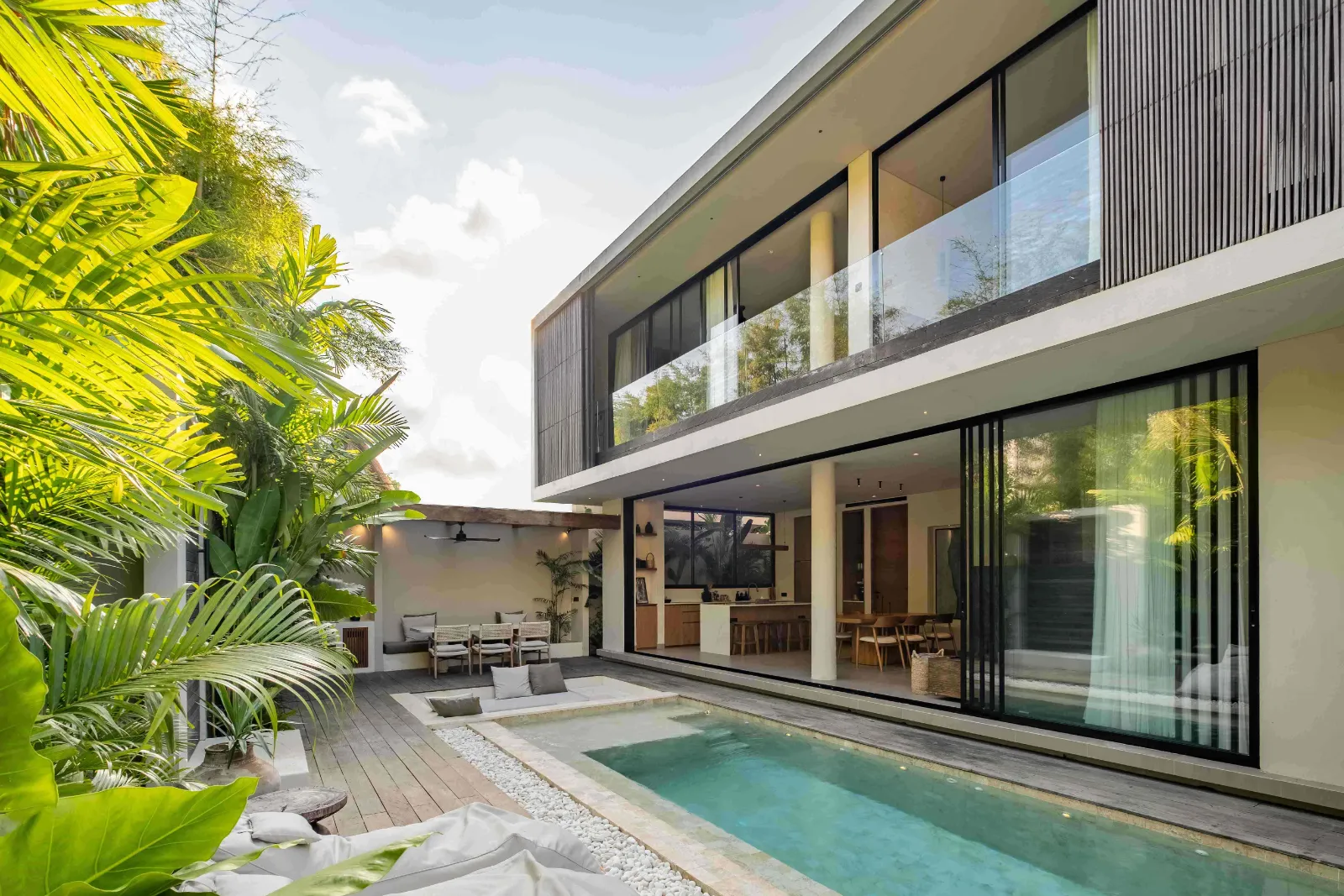
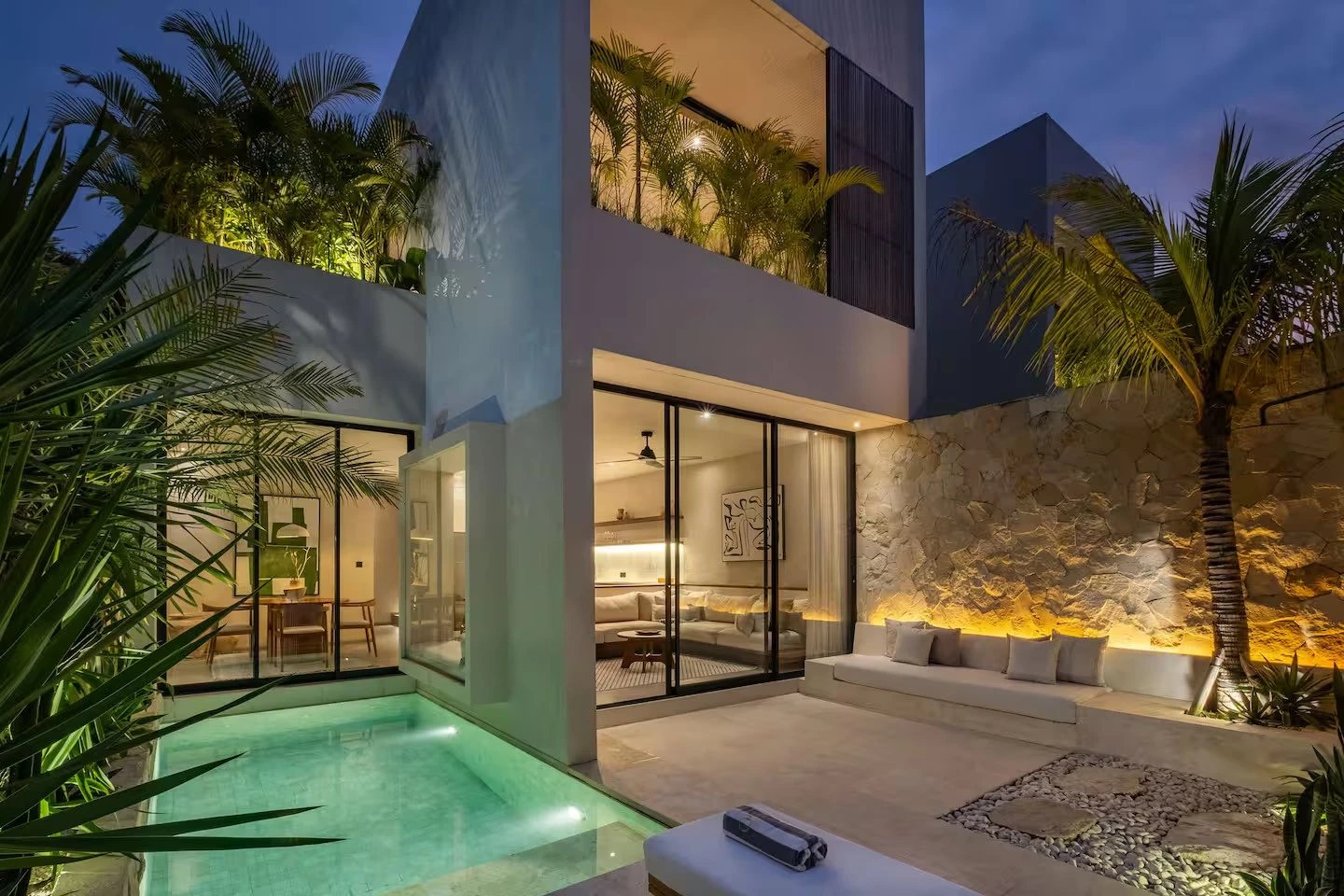
- The Property
- The Full Revenue Waterfall
- The Occupancy Picture
- Month by Month: Occupancy, Rate and Revenue
- What a Normal Month Looks Like at the Booking Level
- How This Compares to the Market
- Why Direct Bookings Change Everything
- What Most Sales Decks Get Wrong
- What the Last Six Months Say About the Next 12
- FAQ
- If You Own a Villa in Uluwatu
- Sources & References
Quick answer
- Gross revenue per villa: $51,474 a year on average, and all four villas landed between $48,000 and $53,500
- Occupancy: 90% of every night in the year, with no nights excluded, and no month below 84%
- Average daily rate: $156 across the year, $165 from March to August, $186 in August
- Owner keeps: about 60% of gross, roughly $30,900 per villa, after OTA commission, our 13% fee and running costs
- Net yield: 12–15.5% on a $200–250K purchase price, about 14% at the midpoint
- Direct bookings: 17% of revenue came direct, so the blended OTA commission was only 14%
Why We’re Publishing This
Every sales deck in Bali shows you a revenue projection. Projected occupancy, projected ADR, projected annual return — all forward-looking, all optimistic, all conveniently free of the months where things go wrong.
This article is the opposite. It’s a backward-looking, 12-month performance summary from four one-bedroom villas we manage in Uluwatu. Using four villas instead of one means a single lucky booking or one bad month can’t flatter or sink the result. Every revenue number comes from actual reservations. The good months are here. So are the bad ones.
We’re publishing it because we think the gap between what buyers are told to expect and what owners actually experience is one of the biggest problems in the Bali villa market. And the fix isn’t better projections — it’s real data from real properties, published openly.
If you’re considering buying a villa in Uluwatu, or if you already own one and want to benchmark your performance, this is the most honest reference point we can give you.
Who We Are and Why That Matters for This Article
Cabo Bali was founded by villa owners and developers whose background is in Google and performance marketing — not hospitality. We built and invested in our own villas before we managed anyone else’s, and we started this company because we couldn’t find a management partner who thought about our properties the way we did: as investments with a return target, not just as listings that needed cleaning between guests.
That background shapes everything. Performance marketing trained us to measure what matters — RevPAR, channel mix, conversion rate, cost per acquisition — and to optimise against real data, not gut feel. Villa development taught us what drives yield from the build stage forward. For the other side of that ledger, see the real monthly cost of owning a Bali villa.
Combining those two skill sets is what Cabo actually is: a management company that treats your villa as a financial asset, not a hospitality project. The full scope is on our Bali villa management page.
Every decision in this article — the pricing strategy, the channel distribution, the direct booking investment, the maintenance response — was filtered through one question: does this protect or improve the owner’s yield? That’s not a tagline. It’s the operating model.
We publish data like this because investment-grade management should come with investment-grade transparency. If your current manager can’t show you numbers like these, that gap is worth understanding.
The Property

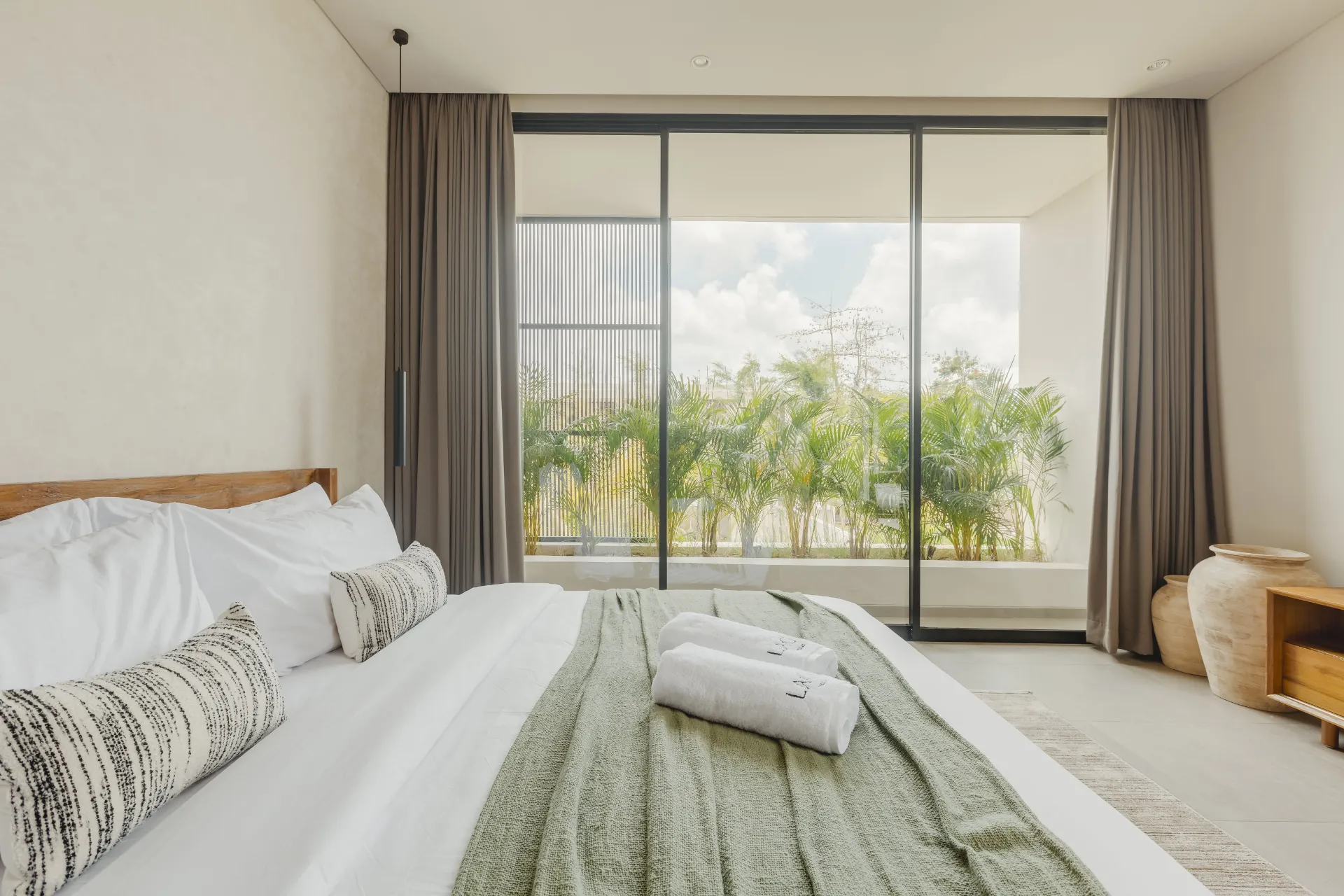
- Villas: four 1-bedroom villas, each with a private pool
- Location: Uluwatu, on the Bukit Peninsula
- Management: Cabo Bali
- Period covered: 1 September 2025 to 31 August 2026 (1,460 villa-nights)
- Channels: Airbnb (75% of revenue), direct bookings (17%), Booking.com (7%), Trip.com (1%)
- Pricing: Dynamic pricing via PriceLabs
- Purchase price range used for yield: $200,000–$250,000 per villa
The Full Revenue Waterfall
Here’s what happens to every dollar a guest pays — from the gross booking amount down to what the owner actually receives.
Where the money went, per villa, September 2025 to August 2026
| Category | USD per villa | % of Gross |
|---|---|---|
| Gross booking revenue | $51,474 | 100% |
| OTA commissions (Airbnb, Booking.com, Trip.com) | –$7,206 | –14% |
| Management fee | –$6,692 | –13% |
| Net revenue to owner | $37,576 | 73% |
| Operating expenses (housekeeping, pool, garden, utilities, staff, maintenance, admin fee) | –$6,692 | –13% |
| Owner profit (before tax) | ~$30,900 | ~60% |
Running costs came in lower than the year before, when they ran at 13–20% of gross.
On a $200–250K purchase, $30,900 is a 12–15.5% net yield: 15.5% at $200K, 13.7% at $225K and 12.4% at $250K.
The commission line is where direct bookings pay off. With 17% of revenue booked direct, these villas paid 14% in OTA commission instead of the 16–17% a villa that relies on Airbnb alone pays.
The Occupancy Picture
| Metric | Sep 2025 to Aug 2026 | Mar to Aug 2026 |
|---|---|---|
| Villa-nights available | 1,460 | 736 |
| Villa-nights booked | 1,317 | 668 |
| Occupancy | 90% | 91% |
| Average daily rate | $156 | $165 |
| RevPAR | $141 | $149 |
| Bookings | 356 | — |
Four villas, one result
| Villa | Occupancy | Avg rate | Gross revenue |
|---|---|---|---|
| Villa A | 92% | $157 | $52,630 |
| Villa B | 89% | $165 | $53,466 |
| Villa C | 90% | $147 | $48,254 |
| Villa D | 90% | $156 | $51,546 |
The spread between the best and the weakest villa is about $5,000 a year. That consistency is the point: the result comes from how the villas are run, not from one lucky listing.
The rate story is the one to watch. The villas averaged $148 a night from September to February and $165 from March to August, reaching $186 in August. The 12-month average of $156 understates where they price today.
Month by Month: Occupancy, Rate and Revenue
Here is every month of the year, averaged across the four villas, straight from the reservations.
| Month | Occupancy | Avg rate | Revenue per villa |
|---|---|---|---|
| Sep 2025 | 88% | $180 | $4,729 |
| Oct 2025 | 95% | $173 | $5,117 |
| Nov 2025 | 90% | $144 | $3,888 |
| Dec 2025 | 91% | $134 | $3,795 |
| Jan 2026 | 90% | $136 | $3,766 |
| Feb 2026 | 84% | $114 | $2,691 |
| Mar 2026 | 89% | $138 | $3,805 |
| Apr 2026 | 94% | $150 | $4,249 |
| May 2026 | 93% | $160 | $4,614 |
| Jun 2026 | 92% | $174 | $4,820 |
| Jul 2026 | 89% | $179 | $4,929 |
| Aug 2026 | 88% | $186 | $5,072 |
| Full year | 90% | $156 | $51,474 |
What the numbers tell you
Occupancy barely moves; rate does the work. Every month ran between 84% and 95% full. Revenue per villa swings from $2,691 in February to $5,117 in October almost entirely because of the nightly rate.
The wet season costs rate, not bookings. November to March stayed 84–91% full at $114–144 a night. Dynamic pricing fills the villas at a lower rate rather than leaving them empty, then pushes the rate back up from April.
Dry season is where the year is made. June to October ran at $173–186 a night at close to 90% occupancy.
Pro tip for owners. Don’t judge your villa by its worst month. Judge it by the 12-month view. February is the slowest month in Bali for almost everyone; what matters is whether the dry-season months make up for it. Ask your manager for the full year, not the monthly snapshot.
What a Normal Month Looks Like at the Booking Level
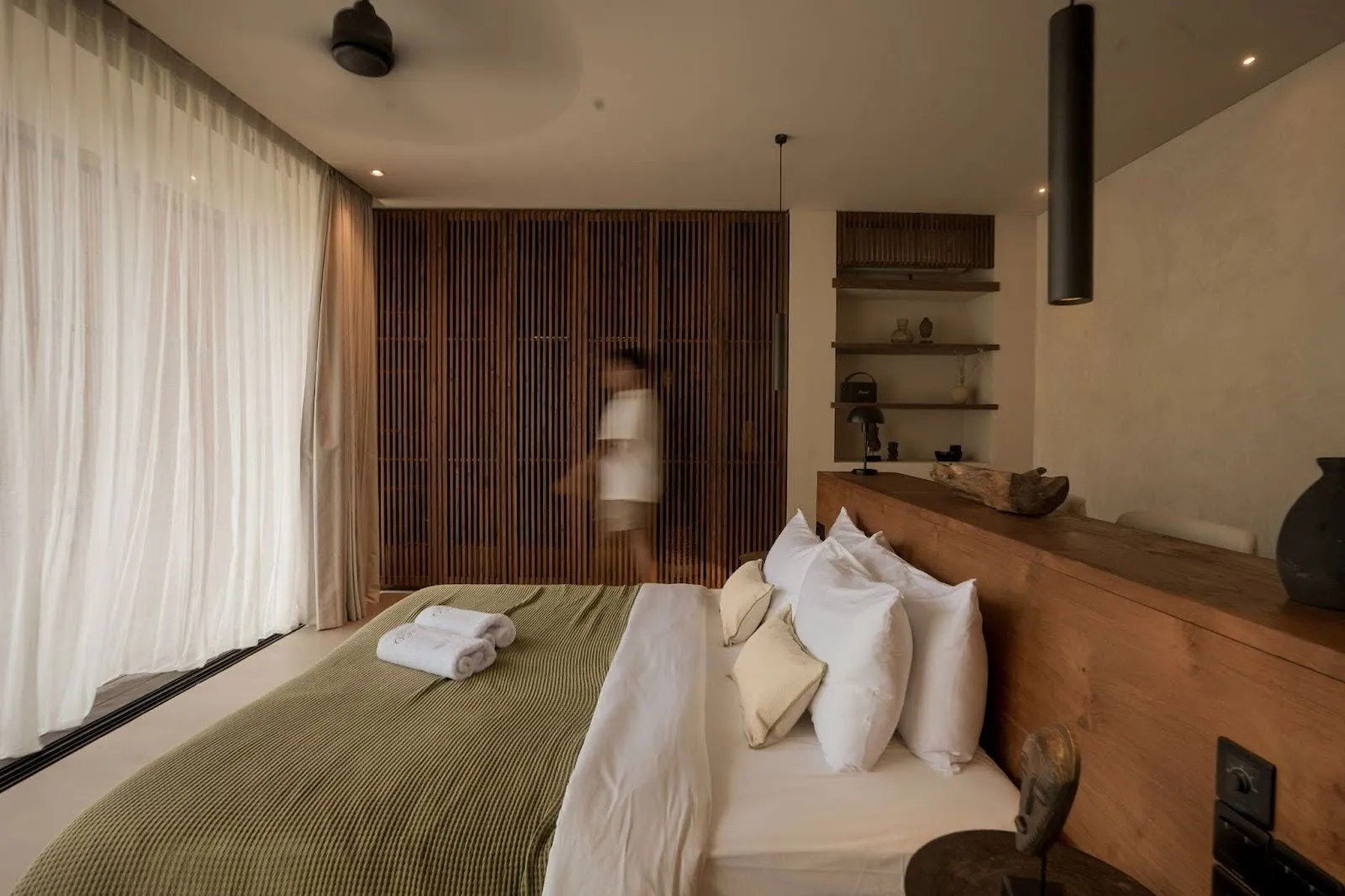
Across the year the four villas took 356 bookings. Most were short: 209 of them, about 6 in 10, were three nights or fewer, which is typical for one-bedroom couples’ villas in Uluwatu.
The long stays are where the yield lives. One guest booked 33 nights over Christmas and New Year at $173 a night, direct with us, with no OTA commission at all. Another took 29 nights in July at $184 a night. One check-in, one deep clean, less wear, and a guest who has time to enjoy the villa properly.
Direct bookings brought in 17% of revenue this year. Every one of those bookings avoided the OTA commission entirely, which is why we keep investing in the channel.
How This Compares to the Market
AirDNA benchmarks the South Kuta / Bukit Peninsula market at around 70% occupancy, a $90 average rate and $55 RevPAR (accessed April 2026). Across the full year these villas ran at:
- Occupancy: 90% of all nights
- ADR: $156, and $165 from March to August
- RevPAR: $141, about 2.5 times the market figure
The outperformance is real, but it is conditional. These villas are well built, well located, well photographed, and actively managed with dynamic pricing across several channels. The location sets the rate ceiling; execution decides whether you reach it.
A 1-bed villa in Uluwatu with average photos, static pricing and a single channel would not produce these numbers.
Why Direct Bookings Change Everything
Most villa management companies in Bali are entirely dependent on OTAs. Every booking comes through Airbnb or Booking.com, every dollar of revenue is subject to their commission, their policies, and their leverage.
That’s a problem, and not only because of the 16–17% commission.
OTAs have leverage over your villa. When a guest complains on Airbnb, the platform can issue refunds from your payout without your approval. When Airbnb changes its review algorithm, your ranking can shift overnight. When Booking.com adjusts commission rates — which they do — your margin compresses with no negotiation. When an OTA decides to favour hotels over villas in search results, your visibility drops and there’s nothing you can do about it.
Every booking that comes through your own direct channel removes that leverage entirely. The guest pays you directly. The review lives on your terms. The refund decision is yours, not the platform’s. And the 16–17% commission stays in your pocket.
This is why we push direct bookings hard. It’s not just a margin play — it’s a risk-reduction strategy. The more of your revenue that flows through your own channel, the less exposed you are to platform decisions that you don’t control and can’t predict.
We invest in building each villa’s direct booking presence through cabobali.com — professional listing pages, direct booking incentives (guests save vs OTA pricing), and a guest experience that drives repeat bookings and referrals outside the platform ecosystem.
Pro tip for owners. Ask your management company what percentage of your bookings come through direct channels. If the answer is zero — or if they don’t have a direct booking channel at all — every dollar of your revenue is subject to OTA commission, OTA refund policies, and OTA algorithm changes. The more you push direct bookings, the more you protect your villa’s profits and reduce your exposure to platform risk. This is one of the clearest signals of whether your manager is working in your interest or just listing you on Airbnb and waiting.
What Most Sales Decks Get Wrong
If a broker showed you one of these villas before purchase, their sales deck would probably have projected 80% occupancy at $180 ADR, with expenses hand-waved at "approximately 20–30% of revenue." That would give you a projected owner profit well above what the actual result was.
The gap isn’t because the villas underperformed. They significantly outperformed the market benchmark. The gap exists because sales decks systematically understate OTA commissions, forget about maintenance reserves, ignore the months where things go wrong, and assume every month performs like August.
This is why we publish real numbers. Not to discourage investment: the returns here are strong at a 12–15.5% net yield. But to set the expectation correctly so that year one doesn’t feel like a disappointment when it’s actually a success.
Pro tip for buyers. Ask your broker to show you performance data like this — 12 months, occupancy and margins, the bad months included. Not a projection. Not a model. Actual historical performance from a comparable villa managed by a real operator. If they can’t produce it, treat their projections with appropriate skepticism. See a full breakdown of what each cost category covers →
What the Last Six Months Say About the Next 12
Three things point to a stronger year ahead:
- The rate has stepped up. $148 a night from September to February, $165 from March to August, and $186 in August.
- Running costs are down. About 13% of gross, against 13–20% the year before.
- Direct bookings are growing. 17% of revenue came direct this year, and every extra direct booking lifts the owner’s share.
Hold occupancy at 90% and carry the March-to-August rate of $165 across the whole year, and gross revenue per villa moves to around $54,200 with the owner keeping about $32,500. That is a forward view, not a result, and we will publish the actual numbers when the year is done.
Key takeaways
- Four real 1-bed villas in Uluwatu grossed an average of $51,474 each from September 2025 to August 2026, from actual reservations, not a projection.
- They were 90% occupied across all 1,460 villa-nights at a $156 average rate, rising to $165 in the second half of the year.
- After 14% OTA commission, our 13% fee and 13% running costs, the owner keeps about 60% of gross, a 12–15.5% net yield on a $200–250K purchase.
- All four villas landed within about $5,000 of each other. The result comes from how they are run, not luck.
- 17% of revenue came direct. Growing that share is the biggest margin lever left.
FAQ
How much does a 1-bedroom villa in Uluwatu earn?
Across four 1-bed villas we manage, the average was $51,474 gross in the 12 months to August 2026, at 90% occupancy and a $156 average nightly rate. After OTA commission, management and running costs, the owner kept about $30,900 per villa.
Is a 12–15.5% net yield realistic for a 1-bed in Uluwatu?
On a $200–250K purchase with active management, yes. This is actual performance from real reservations: 15.5% at $200K, 13.7% at $225K and 12.4% at $250K.
Why use four villas instead of one?
One villa can be flattered by a single long booking or dragged down by one bad month. Four villas over 1,460 nights give a result an owner can actually plan around. All four landed between $48,000 and $53,500.
Why is the rate lower from November to March?
That is Bali’s wet season. The villas stayed 84–91% full, but at $114–144 a night. Dynamic pricing fills the villas at a lower rate rather than leaving them empty.
Can the owner still use the villa?
Yes. No restrictions on owner stays and no commission on personal use. The admin fee still applies because the team keeps maintaining the villa.
What channels generate the bookings?
Airbnb brought 75% of revenue, direct bookings 17%, Booking.com 7% and Trip.com 1%. Because 17% came direct, the blended OTA commission was only 14% of gross.
Is this performance typical of Cabo’s portfolio?
It sits in line with the portfolio, which runs at 91% average occupancy. These four villas averaged 90% across every night of the year.
If You Own a Villa in Uluwatu
If you’re reading this and your 1-bed isn’t hitting these numbers, the question isn’t whether the market supports it — it does. The question is what’s holding your villa back: pricing, photography, channel mix, operational standards, or management.
We’re happy to look at your current performance and give you an honest read on where the gap is. No pitch. No pressure. Just the data.
About the author. Rissa Prima is Digital Marketing Manager at Cabo Bali, which manages boutique villas across Uluwatu, Bingin and Canggu. Rissa writes from the operator's side of Bali villas — real numbers, real guest feedback, and lessons from the team running the portfolio day to day.
Related reading:
- How Much Does Bali Villa Management Cost? A Full 2026 Breakdown
- Best Villa Management Companies in Bali 2026
- How We Hit 91% Occupancy in Under 3 Months
- Bukit Peninsula Villa Investment: What Actually Returns (2026)
- How to Choose a Villa Management Company in Bali
Sources & References
The performance figures in this guide come from the reservations of four one-bedroom villas we manage in Uluwatu, between 1 September 2025 and 31 August 2026, exported from PriceLabs on 21 September 2026. Management fee and running costs come from Cabo Bali’s owner terms and the villas’ operating costs. Market benchmarks and methodology are anchored to the independent sources below.
- AirDNA — Bali / Bukit Peninsula short-term rental market data (South Kuta / Bukit benchmark: ~70% occupancy, ~$90 ADR, ~$55 RevPAR; accessed April 2026).
- PriceLabs: dynamic pricing engine for these villas, and source of the reservation export.
- Airbnb Help Center — service fees (OTA commission across these villas averaged 14% of gross, thanks to 17% direct bookings).
- Booking.com Partner Hub — commission and payment terms.
- BPS Bali (Statistics Indonesia) — Bali tourism and accommodation occupancy statistics.
- Bali Hotels Association — accommodation market context.
- Horwath HTL — Indonesia hospitality market reports.
- Colliers Indonesia — hospitality and real-estate research.
- STR (CoStar) — RevPAR and occupancy methodology.
- Bank Indonesia — Rupiah settlement requirement for transactions in Indonesia.
All villa figures are from actual reservations, September 2025 to August 2026, presented in approximate USD for international readability; transactions are priced and settled in IDR. AirDNA South Kuta / Bukit Peninsula market data current as of April 2026. Cabo Bali is a villa management company, not a legal, tax, or financial advisor — engage independent licensed advisors before any investment decision.