

By Rissa Prima, Digital Marketing Manager, Cabo Bali
Quick answer
- You can't judge a Bali villa manager from marketing — they all promise the same thing, so evaluate with specific questions and evidence.
- Ask the eight questions: provable occupancy data, the full fee structure, listing and pricing approach, emergency response, property protection, reporting, onboarding, and owner references.
- Compare total monthly cost — commission plus software, hosting, consumables and maintenance markups — not the headline commission rate.
- Watch for red flags: won't share occupancy or a full monthly report, no property audit at onboarding, one-line quarterly reports, and long contracts with no exit.
- Score each company 1–3 per question; 20–24 is a strong candidate, under 14 means keep looking.
The Cabo Bali Evaluation Framework
What to ask, what to check, and what separates a management company that makes you money from one that costs you money.
There are over a hundred villa management companies in Bali. Some are excellent. Most are mediocre. A few will actively cost you money while charging you for the privilege.
The problem is they all say the same things on their websites. "Professional management." "Maximise your returns." "Hassle-free ownership." It's meaningless. You can't evaluate a management company from their marketing because they're all marketing the same promise. Overseas owners have a slightly different checklist — we cover it in managing a Bali villa from abroad.
We run a boutique management company in Bali at 91% occupancy against a market average of 55-65%. But we're also villa owners and developers ourselves — we've sat in every chair at the table. We know what it's like to hand your property to someone and hope they treat it like their own. We know what it's like to build a villa and then realise the management company doesn't understand what you built or why. And we know what it's like to get a monthly report that raises more questions than it answers. If the two categories still blur, we separate them in property management vs villa management.
We're not the right fit for everyone and we're not pretending to be. But having operated from the owner's side, the developer's side, and the management side, we've seen what good and bad looks like from every angle.
This is the evaluation framework we'd want someone to use if they were assessing us. If a management company can't answer these questions clearly, that tells you everything.
Own a villa in Bali? See how Cabo manages villas end to end →
On this page

The 8 Questions That Actually Matter
1. What's your actual occupancy rate — and can you prove it?
2. What's your fee structure — all of it?
3. How do you handle listing optimisation and pricing?
4. What happens when something breaks at 9:30pm?
5. How do you protect my property from damage?
6. What reporting do I get and how often?
7. What does your onboarding process look like?
8. Can I talk to your current owners?
These aren't trick questions. A good management company will answer all of them without hesitation.
1. What's Your Actual Occupancy Rate?
Every management company will tell you they achieve "high occupancy." Push past that. You need numbers.
Ask for: Portfolio-wide occupancy for the last 12 months, broken down by property. Not cherry-picked months. Not projections. Actual data.
But occupancy alone isn't enough. A villa can be 90% occupied and still losing money if the rates are too low or the costs are too high. Ask them to share a full monthly report so you can see the numbers — line item by line item. Revenue, expenses, net payout. Occupancy without financial context is a vanity metric.
What good looks like: 75%+ across the portfolio with seasonal variation explained. Anyone claiming 90%+ year-round is either exceptional or lying — verify which.
What bad looks like: "It depends on the property" with no numbers. Or quoting peak season as the full year.
Red flag: Can't or won't share occupancy data. If they're performing well, they'll show it.
The Bali average sits around 55-65% (AirDNA). A management company should significantly outperform that or you're paying someone to achieve what you could do yourself with a channel manager and a cleaner.
Pro Tip: Ask for the occupancy rate of properties similar to yours— same area, bedroom count, price tier. Portfolio-wide averages can be inflatedby one or two outlier properties.
2. What's Your Fee Structure — All of It?
This is where most owners get caught. The headline commission rate is rarely the whole picture — and it's the easiest number to compare, which is exactly why it's misleading.
Commission is only one part of total cost. The real question is: what does a full month actually cost me? Most owners don't find out until they're three months in and the invoices start piling up.
Common commission structures
Commission only (15-25%). Simple headline, but during owner occupancy or low season the company earns nothing but still has costs. Some deprioritise your property in response.
Commission plus admin fee. Lower commission (10-15%) plus a fixed monthly or per-booking fee. More transparent about true costs.
Fixed monthly fee. Rare for individual villas. More common for large portfolios.
But commission is just the start. Ask about the full cost stack:
Software costs. Channel managers, dynamic pricing tools, PMS, guest communication platforms — who pays? Some absorb into commission, others pass through. Can add IDR 500k-2M+ per month.
Host / guest-facing staff. Who pays for guest communication, check-ins, on-the-ground coordination? Included in commission or separate fee?
Villa manager / property manager. Inspections, maintenance coordination, housekeeping oversight — in the commission or on top?
Housekeeping. Included or charged per turnover? Deep cleans, laundry, pool maintenance?
Consumables. Toiletries, cleaning supplies, pool chemicals, coffee, welcome drinks. Who buys, who pays?
Maintenance. Markup on contractor invoices? Some add 15-30% as a "coordination fee" without disclosing it.
The best thing you can do: Ask for a full monthly report from one of their current properties (anonymised). Not a projection — an actual month with every line item. That gives you the real number, not the headline number.
It's easy to compare on commission alone. 15% vs 18% vs 22%. But when you add the full cost stack, a company at 15% plus separate fees can cost more than one at 20% all-in.
Red flag: Can't give you a clear written breakdown within 24 hours.
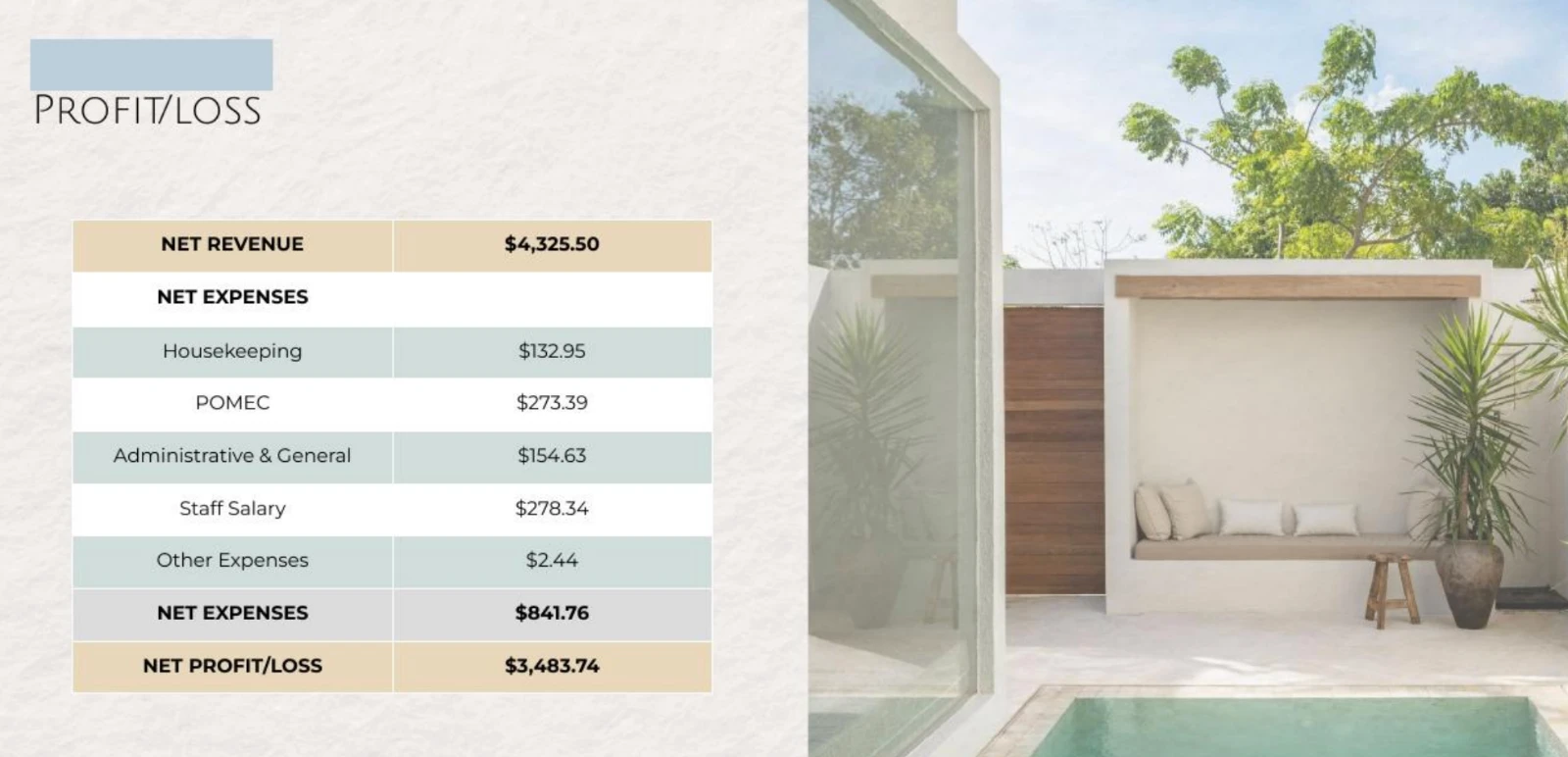
Pro Tip: The cheapest commission is almost never the best value.Model total monthly cost against revenue generated. A company charging more but delivering 25% higher occupancy is a better deal.
3. How Do You Handle Listing Optimisation and Pricing?
This is where the gap between good and average is widest. Listing on Airbnb is easy. Optimising to convert is where money is made.
Photography. Who shoots? How often updated? Lead shot strategy? The first image accounts for the majority of click-through decisions.
Listing copy. Who writes it? Optimised for OTA search? Updated seasonally?
Pricing strategy. Dynamic pricing tools? Which ones? Approach to last-minute bookings?
Channel management. Which OTAs? Channel manager to sync calendars? Manual management means double-bookings.
Direct booking strategy. Direct bookings avoid 15-18% OTA commission. Any direct channel?
What good looks like: Professional photos refreshed annually, dynamic pricing (PriceLabs, Beyond, Wheelhouse), 3-5 OTAs via channel manager, some direct booking channel.
What bad looks like: Owner's photos, static pricing, Airbnb only, no direct booking effort.
Pro Tip: Ask to see actual listings before signing. Mediocre photos, generic descriptions, no pricing variation — that's your villa's future.
Pro Tip: Check their website. How do they structure and promote each villa? Its own identity and professional shots, or copy-paste templates?That tells you exactly how much attention your villa will get.
4. What Happens When Something Breaks at 9:30pm?
Pool pumps fail. AC units die. Plumbing backs up. The question isn't whether — it's how fast it gets handled.
- 24/7 guest contact?
- Who responds first — on-site person, call centre, or owner?
- On-call maintenance staff or contractors?
- Average response time for urgent issues?
- Emergency spend threshold without owner approval?
What good looks like: On-site or nearby staff, 30-minute response, a night engineer on call for after-hours emergencies, pre-approved maintenance budget, established contractor relationships.
We have a night engineer across our portfolio. When a guest messages at 9:30pm about no hot water or a tripping AC, someone is there within 30 minutes. That's the difference between a 5-star and a 3-star review. Ask: who handles the 9:30pm call? If the answer is "we'll get to it in the morning," that's a morning full of damage to your reviews.
Pro Tip: Ask about preventive maintenance, not just reactive.Quarterly AC service, monthly pool systems, inspection between every guest —that prevents 9:30pm emergencies.

5. How Do You Protect My Property From Damage?
Your villa is an asset worth billions of rupiah. How the management company protects it matters.
Guest screening. What info collected? Policies on parties, exceeding guest count?
Security deposits. How collected and processed? Claim process?
Insurance. Villa insurance is the owner’s responsibility, not the management company’s. But a good company should have recommended insurance partners who understand Bali’s risks — flooding, tropical storms, termite damage, guest liability. If they can’t recommend an insurer, they probably haven’t thought about it for their other owners either.
Check-in / check-out inspections. Documented process with timestamped photos?
What good looks like: Deposits via OTA or third-party, documented inspections, clear guest rules, track record of successful damage claims.
What bad looks like: No deposit, no inspections, “we’ve never had a problem.”
6. What Reporting Do I Get and How Often?
You’re trusting someone with a high-value asset. You should know exactly what’s happening with it.
Ask for a sample report. A company that can’t show one doesn’t have a process.
What a good report includes:
- Revenue by source (OTA vs direct)
- Occupancy rate for the period
- Average nightly rate achieved
- Itemised expense breakdown
- Net owner payout with clear calculations
- Upcoming bookings
- Maintenance or issues log
- Guest review summary
How often: Monthly minimum. Real-time dashboard even better.
What bad looks like: Quarterly PDFs with just a revenue number and a bank transfer.
Red flag: “We send reports when there’s something to report.” If your management company goes quiet, that’s not fine — it’s a sign you’re not being managed.
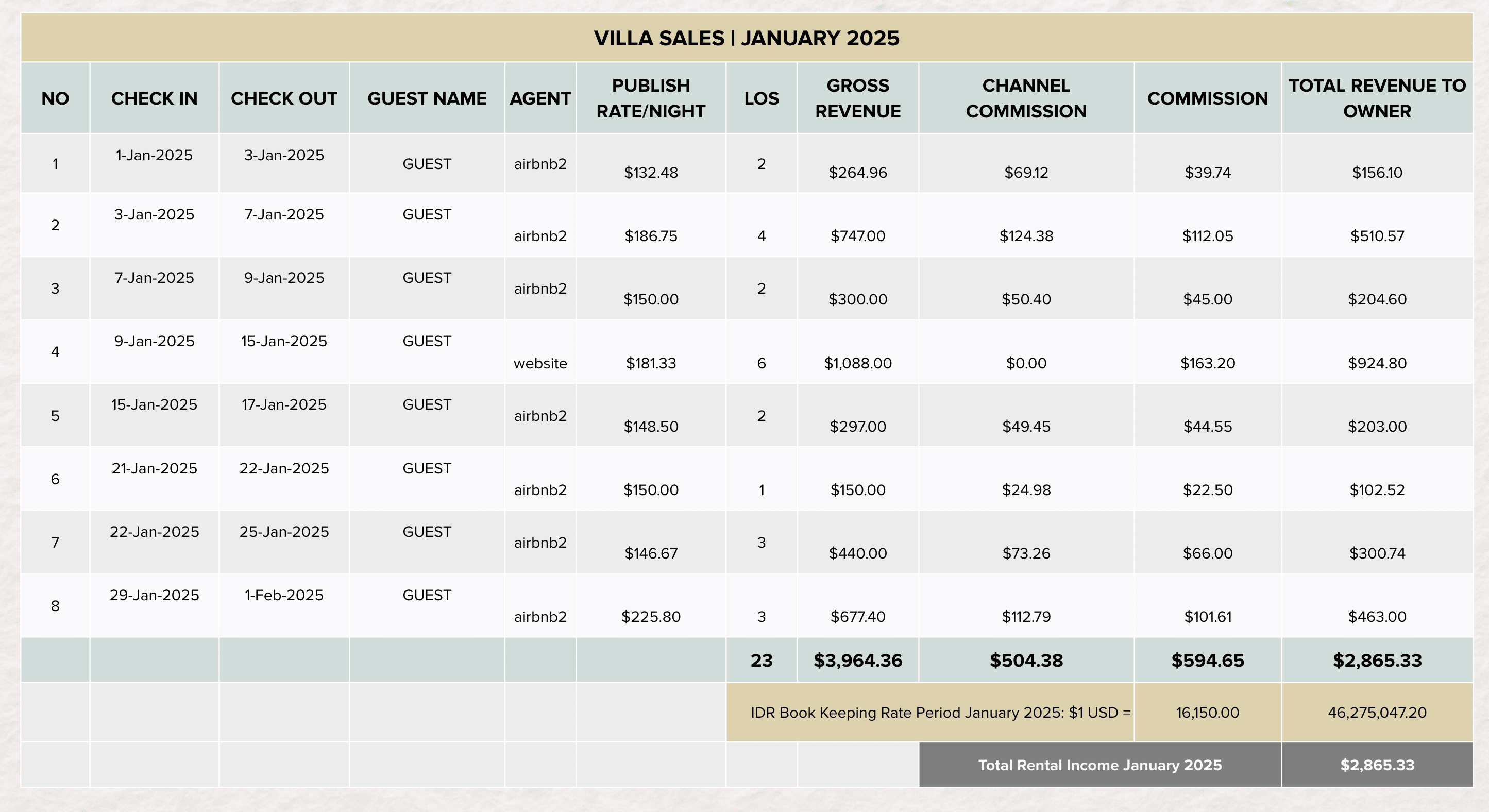
Pro Tip: Ask how maintenance costs are reported. Some companies mark up invoices 15-30% as a “coordination fee” without disclosing it.
7. What Does Your Onboarding Process Look Like?
The transition period tells you a lot about how a company operates.
What good onboarding looks like:
- Property audit — condition and readiness assessed before first booking
- Listing creation — professional photography, optimised copy, pricing set
- Operational setup — staff, supplies, contractor relationships established
- Owner alignment — fees, owner-use policies, communication, 3-month review point
- Timeline — 2-4 weeks from agreement to first booking
What bad looks like: “Send us the keys.” No audit, no setup. Your villa goes live with whatever’s there.
Pro Tip: The property audit is the most important step. Withoutit, the company learns what needs fixing through bad reviews. That costs youmoney and ranking.
8. Can I Talk to Your Current Owners?
The simplest due diligence. Any confident company will connect you with clients.
Ask for: 2-3 owners — someone 12+ months, and someone recent.
Questions for those owners:
- How’s communication — proactive or only when there’s a problem?
- Have there been any surprise charges?
- How accurate were projections vs reality?
- Would you sign again?
- What’s the one thing you’d change?
Red flag: Refusal to connect you with a single existing client.
The Evaluation Scorecard
Score each question 1-3 per company:
3 = Clear, specific, confident answer with evidence
2 = Reasonable but vague on details
1 = Evasive, generic, or couldn’t answer
| Question | Company A | Company B | Company C |
|---|---|---|---|
| 1. Occupancy data | |||
| 2. Fee transparency | |||
| 3. Listing optimisation | |||
| 4. Emergency response | |||
| 5. Property protection | |||
| 6. Reporting quality | |||
| 7. Onboarding process | |||
| 8. Owner references | |||
| TOTAL |
20-24: Strong candidate. Final due diligence and move forward.
14-19: Decent but gaps. Clarify weak areas before committing.
Under 14: Keep looking. Too many unknowns.
What We Learned From Owners Who Switched to Us
We don’t take every villa. But we’ve onboarded from self-managed owners and from other companies. Because we’re owners and developers ourselves, we’re not just hearing about these problems — we’ve lived them on the other side of the table. The patterns are consistent:
Poor communication is the #1 reason owners leave. Not poor occupancy. Owners tolerate quiet months. They can’t tolerate not knowing what’s happening with their property.
Cheap fee structures often aren’t cheap. Lowest commission plus software fees, host costs, consumables, and maintenance markups can total more than a higher commission all-in. Always ask for a full monthly report.
Photography is the highest-leverage thing a management company does. A listing refresh typically increases bookings 20-30% within the first month.
Proactive maintenance prevents reactive crises. Biggest operational cost saving came from scheduled maintenance rather than waiting for things to break.
The first 3 months set the tone. Onboarding quality predicts long-term management quality.
Common Mistakes Owners Make
Choosing on commission rate alone. 15% plus separate software, hosting, and consumable charges can cost more than 20% all-in. And lower commission with lower occupancy is always a bad trade.
Not checking current listings. Every property they manage is publicly visible on the OTAs. Look at the photos, descriptions, and reviews.
No break clause. 12 months with 90-day notice is standard. 24 months with no exit is a trap.
Ignoring the local team. Meet the housekeepers and maintenance staff, not just the sales team.
Assuming bigger is better. 200 villas = systems. 10 villas = attention. Neither automatically wins.
Contract Terms to Watch For
- Length + exit: 12 months,90-day notice. Avoid 24+ months with no exit.
- Exclusivity: Normal — but check if it covers your own direct bookings.
- Owner-use periods: Notice period, fees, booked-period conflicts.
- Maintenance authority: Spending threshold for repairs without approval.
- Inventory: Documented at start. What happens to your items at contract end?
- Revenue disbursement: When paid, whether OTA funds flow through them or to you.
Frequently asked questions
What occupancy should a good Bali villa manager achieve? The Bali average sits around 55–65%; a good company should significantly outperform that, with 75%+ across the portfolio and seasonal variation explained.
Why isn't the commission rate enough to compare? Commission is only one part of total cost; software, host and staff, housekeeping, consumables and maintenance markups can make a 15% company cost more than a 20% all-in one.
How fast should a manager handle a 9:30pm emergency? Good operators have on-site or nearby staff and a night engineer on call, responding within about 30 minutes — the difference between a 5-star and a 3-star review.
What should a monthly report include? Revenue by source, occupancy, average nightly rate, itemised expenses, net owner payout, upcoming bookings, a maintenance log, and a guest review summary — monthly at minimum.
What contract terms should owners watch for? A 12-month term with 90-day notice is standard; avoid 24+ months with no exit, and check whether exclusivity covers your own direct bookings.
Can I speak to a company's current owners? Yes — any confident company will connect you with two or three owners, including someone 12+ months in and someone recent; refusal is a red flag.
Key takeaways
- You can't evaluate a manager from marketing; use the eight-question framework and demand evidence.
- Verify actual occupancy broken down by property, not cherry-picked months or projections.
- Compare the full cost stack, not headline commission, and ask for a real itemised monthly report.
- Listing optimisation and photography is where the gap between good and average is widest.
- Emergency response, property protection, and quality reporting protect your asset and your reviews.
- Poor communication — not poor occupancy — is the number one reason owners leave, and onboarding quality predicts long-term quality.
Not sure you need a full management company at all? Compare the two models in our guide to a villa management company vs a booking agent.
Working With Cabo Bali
We manage a small, curated portfolio of villas in Bali. We’re selective because our occupancy and reputation depend on every villa performing.
If you’re evaluating management companies — or wondering whether your current one is delivering — use this framework. If you’d like to discuss whether your property fits our portfolio, we’re happy to talk. No pitch, no pressure — just an honest assessment.

Sources: AirDNA Bali market data 2024-2025, Cabo Bali portfolio performance data 2023-2025, STR Global accommodation benchmarks.
About the author. Rissa Prima is Digital Marketing Manager at Cabo Bali, which manages boutique villas across Uluwatu, Bingin and Canggu. Rissa writes from the operator's side of Bali villas — real numbers, real guest feedback, and lessons from the team running the portfolio day to day.