
By Rissa Prima, Digital Marketing Manager, Cabo Bali · Updated 26 June 2026 · 5 min read

Quick Summary — 5 minute read
- The management fee is one of four cost categories — you need to understand all of them.
- A good management fee covers all staff, software, marketing and reporting. You should not be separately invoiced for these.
- Channel commissions (Airbnb, Booking.com) typically run 15–17% of gross and come off first.
- Operating expenses — housekeeping, pool, garden, utilities, repairs — are passed through at cost with zero markup.
- A well-managed villa in Uluwatu or Canggu should return approximately 50–60% of gross revenue to the owner as profit.
- Always ask: is the commission on gross or net? Do they mark up costs? Do they have in-house engineers?
Own a villa in Bali? See how Cabo manages villas end to end →
On this page
- How Much Does Villa Management Cost in Bali? The Short Answer
- Why the Commission Rate Alone Misleads You
- The Four Cost Categories Every Owner Should Understand
- The Management Fee: What It Should — and Shouldn't — Cover
- Commission Structures: What's Common in Bali
- Channel Commissions: The Cost That Comes First
- Real Numbers: What the Costs Actually Look Like in Uluwatu
- A Note on Taxes
- What to Ask Before Signing a Management Agreement
- What our own owners actually keep
- Frequently Asked Questions
How Much Does Villa Management Cost in Bali? The Short Answer
Total villa management cost in Bali runs between 28% and 38% of gross revenue once you combine every category that appears on your monthly statement. The management fee itself is 13–20% of gross. OTA channel commissions take another 15–17%. Operating expenses — housekeeping, pool, garden, utilities, repairs — run 10–15%. What a well-managed owner actually keeps, before Indonesian tax, is approximately 50–60% of gross revenue. With a single property the maths is tighter — we run it in is a villa manager worth it for one villa?
The headline commission rate — the number every management company leads with — is just one piece of that. An owner paying a "15% management fee" and an owner paying "13% plus a flat admin fee" can end up with the same net margin, or wildly different ones, depending on what's included and what's billed separately.
This article breaks down every cost category with real numbers from villas we manage in Uluwatu. Read it before you sign anything — or before you renew.
Why the Commission Rate Alone Misleads You
Most conversations about villa management in Bali start and end with the commission percentage. That's a mistake. The management fee is just one part of your total cost structure — and in many months, it's not even the largest one.
Understanding what you're actually paying requires breaking the numbers into every category: the management fee, channel commissions, operating expenses, and taxes. Each one behaves differently, and each one varies significantly depending on who you're working with and how the contract is written.
The Four Cost Categories Every Owner Should Understand
Every dollar that flows through a Bali villa management arrangement falls into one of these four categories. Before comparing companies, you need to understand all four — not just the one they lead with.
Still deciding between full management and a lighter-touch arrangement? Our comparison of a villa management company vs a booking agent sets out which of these four cost categories each model actually covers.
| Category | Fixed? | What It Covers | Can You Reduce It? |
|---|---|---|---|
| Management Fee | Negotiated | Staff, software, marketing, reporting — the cost of running your villa as a business | Compare carefully — see below |
| Channel Commission | Platform-set | OTA fees (Airbnb, Booking.com, etc.) — deducted before anything else | Yes — via direct bookings |
| Operating Expenses | Variable | Housekeeping, pool, garden, utilities, maintenance — passed through at cost | Yes — via tight management and in-house engineers |
| Taxes | Statutory | Indonesian income tax, VAT on bookings (where applicable) | No — but we have accounting partners who can help |
A good villa management company can help reduce two of these four categories: channel commissions (by building a direct booking channel) and operating expenses (through efficient management and in-house capabilities). The management fee and taxes are what they are — the conversation should be about value within those costs, not just the lowest number.
The Management Fee: What It Should — and Shouldn't — Cover
The management fee pays for running your villa as a business. In a well-structured arrangement, the management company absorbs all operational overhead internally. You are not separately billed for the people and tools they use to do their job.
What a Good Management Fee Includes
The best villa management companies in Bali cover all of the following within their fee — not as add-ons or separate invoices:
- Property management software (PMS, channel manager, dynamic pricing tools such as PriceLabs)
- Villa manager and operations lead salary
- MEP engineer salary (maintenance and engineering staff for day-to-day repairs and upkeep)
- Concierge and guest experience team
- Social media and marketing manager
- Owner reporting, accounting, and compliance
If a management company quotes a low commission and then invoices you separately for their engineer's time, software subscriptions, or marketing spend — that commission figure is not what you think it is. These are internal costs that belong inside the management fee, not passed back to owners.
What You Pay Separately — and Should
Some costs are genuinely the villa's own operating expenses, correctly billed to the owner at cost. These exist regardless of who manages the property:
- Housekeeping — laundry, cleaning supplies, bathroom amenities, welcome gifts
- Pool maintenance — chemicals, equipment, servicing
- Garden maintenance — upkeep, fertilizer, landscaping
- Utilities — electricity, water, internet
- Maintenance and repairs — routine upkeep and ad hoc repairs
- Security — if your property is within a compound or complex
Pro tip: Ask whether your management company has in-house engineers or whether all maintenance is outsourced to third-party vendors. In-house engineers — on the company's payroll — mean faster response times, more accountability, and lower call-out costs. Outsourced maintenance is typically marked up and slower. It's one of the clearest signals of a company that is genuinely invested in your cost base.
Commission Structures: What's Common in Bali
| Model | How It Works | Typical Rate | Best For |
|---|---|---|---|
| Commission-Only | % of gross revenue per booking | 15–20% of gross | Owners who want simplicity |
| Hybrid (Commission + Admin Fee) | Lower % of gross + fixed monthly admin fee covering reporting, accounting and owner comms | 12–14% of gross + fixed IDR monthly | Owners who want full transparency and no restrictions on owner stays |
| Flat Fee | Fixed monthly regardless of bookings | Varies by property | Very high-occupancy, predictable villas |
Cabo Bali operates on a hybrid model: 13% on gross revenue plus a fixed IDR 2,500,000 monthly admin fee. The commission is calculated on the full gross booking value — the amount the guest pays. The fixed admin fee covers all reporting, accounting, bank transfers, and owner communication. Because it's a flat amount, its cost as a proportion of your gross revenue decreases as your villa performs better — at $7,500 gross it represents around 2%, at $10,000 it falls below 1.7%.
An often-overlooked advantage of the hybrid structure is flexibility around owner use. Commission-only arrangements can create tension when you want to stay at your own villa — every night you occupy reduces the manager's income directly. In a hybrid model that tension disappears. There are no limits on owner stays.
Is a 15% Commission a Good Rate in Bali?
A 15% commission-only rate is within the typical range for Bali — most established companies sit between 15% and 20%. Whether it represents good value depends entirely on what's inside it. A 15% rate that covers all staff, software, marketing, and reporting is reasonable. A 15% rate that then bills you separately for engineering callouts, PMS software, or marketing campaigns is not.
The more useful number to compare between companies is your total management cost as a percentage of gross revenue: the commission, any fixed fees, and any additional charges combined. That combined figure is what you're actually paying.
Channel Commissions: The Cost That Comes First
Before your management fee, before operating expenses, before anything else — Airbnb and Booking.com take their cut from every booking. On a villa generating $6,000 in a strong month, channel commissions alone typically exceed $900.
| Channel | Typical Commission | Who Pays It | Negotiable? |
|---|---|---|---|
| Airbnb | 14–17% of gross | Split host + guest | No |
| Booking.com | ~15% of gross | Host | No |
| Direct (your website) | 2–3% (processing only) | Chargeable to guest | N/A — lowest cost channel |
The Direct Booking Advantage
Direct bookings are the highest-margin channel available. Without a platform taking 15–17%, there is room to price your direct channel at 5–10% below OTA rates and still generate meaningfully more profit per booking. The guest pays less. You take home more.
Payment processing fees on direct bookings — typically 2–3% — can also be charged to the guest rather than absorbed by the owner, unlike OTA bookings where this cost is embedded in the structure.
At portfolio level, the impact compounds. If direct bookings account for 20% of your villa's revenue, your blended channel rate drops from 15.5% to approximately 12.9% — a saving of around $150 per month on a villa generating $5,800 gross. That's over $1,800 per year from channel mix alone.
"For me, the biggest win is the direct bookings. Airbnb takes such a big cut these days, so it's great not relying only on that like I did before."
— Camilla, Bali — villa owner, Cabo Bali portfolio
Pro tip: When evaluating a management company, ask what percentage of bookings come through direct channels and what their strategy is to grow that number. A company with no direct booking infrastructure is not working in your interest on channel mix.

Real Numbers: What the Costs Actually Look Like in Uluwatu
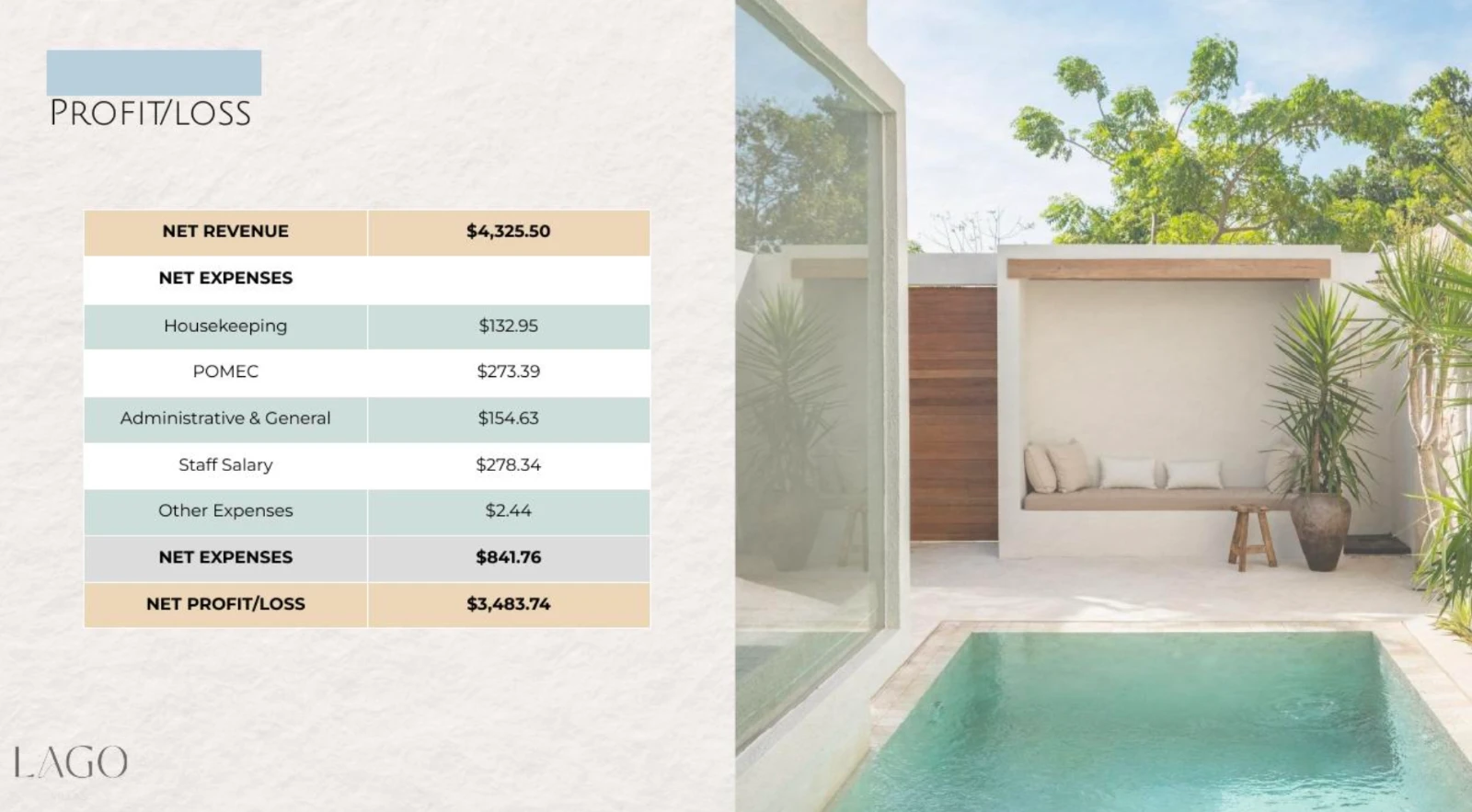
The figures below are averaged from two months of real owner reports across one-bedroom villas we manage in Uluwatu. Not projections. Not industry estimates. Actual numbers from actual monthly statements, broken into every line item.
Basis: gross revenue averaged approximately $5,800/month. Average daily rate approximately $200. Occupancy 95%. All OTA channel — the direct booking impact is shown separately.
| Cost Category | Monthly Average (USD) | % of Gross |
|---|---|---|
| Channel Commissions | ||
| Gross Revenue | $5,834 | 100% |
| OTA Channel Commission (Airbnb / Booking.com) | − $904 | 15.5% |
| ↳ With 20% direct bookings (blended rate 12.9%) | − $753 (save $151/mo) | 12.9% |
| Management Fee | ||
| Management Commission (13% of gross) | − $758 | 13.0% |
| Admin Fee — flat IDR 2,500,000/month (approx. USD 157) | − $157 | 2.7%* |
| Operating Expenses — all passed through at cost, zero markup | ||
| Housekeeping (amenities, laundry, supplies, welcome gifts) | $138 | 2.4% |
| Pool & Garden maintenance | $10–60† | 0.2–1.0% |
| POMEC — electricity, water, maintenance and repairs | $307 | 5.3% |
| Staff Salary — housekeeper, gardener, pool attendant | $283 | 4.9% |
| Bank Transfer Fees | $2 | <0.1% |
| Taxes | ||
| Indonesian income tax / VAT — see note below | Varies | Varies |
| Net Profit to Owner (before tax) | $3,273 | ≈ 56% of gross |
* The admin fee is a fixed IDR amount. At higher revenue months its percentage share falls further — at $8,000 gross it represents under 2%.
† Pool and garden costs vary month to month. POMEC figures are baseline averages — annual costs (internet contracts, waterproofing, pest control) add approximately $100–250/month when amortised.
Industry rule of thumb: a well-managed Bali villa should return approximately 50% of gross revenue to the owner as profit, after all fees, commissions, and operating costs. Our Uluwatu and Canggu portfolio consistently sits above that benchmark at 91% average annual occupancy — roughly double the all-listings Bali market average of about 50–56% reported by AirDNA (2026).
A Note on Taxes
Taxes sit entirely outside the management relationship but are real costs that need to be factored into your return calculations. Indonesian tax law applies to rental income in several ways, and the specific rates and obligations you face depend heavily on your ownership structure, whether you operate through an Indonesian legal entity, and your country of residence.
As a general framework, the main tax categories to be aware of are:
- VAT on short-term accommodation services — applicable to short-term rental income under Indonesian tax law. Treatment and collection method varies depending on your structure and the booking channels you use.
- Income tax on rental earnings — individual owners and corporate entities are subject to different rates and structures. The rules differ further depending on whether your home country has a tax treaty with Indonesia.
- Corporate income tax (PT PMA) — foreign owners operating through an Indonesian foreign-owned company face a separate tax regime on profits.
Tax obligations vary significantly and can materially affect your net return. Always consult a qualified Indonesian tax advisor before modelling your numbers — not after.
What to Ask Before Signing a Management Agreement
Most owners compare headline commission rates and stop there. These questions reveal far more:
- Is the commission calculated on gross revenue? Some companies charge on the amount after OTA commissions are deducted. Others charge on the full gross booking value. The difference is material — always confirm.
- What is and isn't included in the management fee? Get a written list. Staff, software, marketing, and reporting should all be inside the fee.
- Are operating expenses passed through at cost with documentation? Every line item should appear in your monthly report with a description. Ask for a sample report before you commit.
- Do they mark up maintenance costs? Some companies apply a percentage markup on all repairs and supplies. At-cost pass-through with zero markup is the standard you should expect — and insist on.
- Do they have in-house engineers? Ask specifically whether engineers are on their payroll or called in from outside. In-house means lower costs and faster repairs.
- Are there restrictions on owner stays? Commission-only structures can create friction here. Hybrid structures with a fixed admin component typically remove this tension entirely.
- What is their direct booking percentage and growth strategy? A company with no direct booking infrastructure is leaving money on the table — yours, not theirs.
Pro tip: Ask to see a sample monthly owner report before signing anything. A well-managed villa generates a report that itemises every expense line-by-line, shows every booking with channel and rate, and includes a full bank statement overview. If they can't show you one — or won't — that's your answer.
Key takeaways
- Total cost to run a Bali villa is roughly 28–38% of gross once you add the management fee, OTA commissions and operating expenses — the headline commission is only one line of four.
- A well-managed Uluwatu or Canggu villa returns approximately 50–60% of gross to the owner before tax; our portfolio sits above the 50% benchmark at 91% average annual occupancy.
- The management fee should cover all staff, software, marketing and reporting — if any of those are invoiced separately, your real cost is higher than the quoted rate.
- OTA commissions (15–17%) come off first; growing direct bookings is the single biggest lever to lower your blended channel cost.
- Operating expenses should be passed through at cost with zero markup and full line-item documentation.
- Compare companies on total management cost as a percentage of gross — commission plus any fixed fees plus extras — not the headline number.
What our own owners actually keep
Every page on this topic quotes a range. Ranges are easy to write and impossible to check, so here is a real villa from our own portfolio instead, with the numbers we publish and update.
A two-bedroom villa in Bingin, managed by us: ~$80,000 annual gross revenue, ~$44,000 owner profit after every cost, 96% annual occupancy, an ADR of $221 and trending past $250, and a net yield of 14–16% on a $280–330K acquisition. That works out at roughly 55% of gross reaching the owner — inside the 50–60% band above, but measured rather than asserted. The full month-by-month P&L, including the months that went badly, is published in what a 2-bed villa in Bingin actually earns.
The fee structure that produced it is the one described above: 13% of gross revenue plus a flat IDR 2.5 million per month (~$160) for administration, with every operating expense — housekeeping, pool, garden, utilities, repairs — passed through at cost with zero markup. The flat component is deliberately small and deliberately flat: at $7,500 gross it is about 2% of revenue, and above $10,000 it falls below 1%, so it shrinks as a proportion exactly when a villa performs.
The part most fee comparisons miss entirely is channel mix. Move direct bookings to 20% of a villa’s revenue and the blended channel rate drops from 15.5% to about 12.9% — roughly $150 a month on a villa grossing $5,800, or over $1,800 a year, without changing the management fee at all. On the Bingin villa, a single direct booking in August carried 27% of that month’s revenue and saved the owner around $225 in commission on one stay: $48 in payment processing against the $200+ an OTA would have taken for the same nights.
Across the wider portfolio, the same approach runs 91% occupancy against a 55–65% Bali market average and a 4.84 guest rating from 750+ reviews, published quarterly in our portfolio performance report. If a manager will not show you numbers at this level, the honest question is not what they charge — it is what they are not showing you.
Frequently Asked Questions
How much does villa management cost in Bali?
Total villa management cost in Bali typically runs between 28% and 38% of gross revenue when you account for all categories: channel commissions (15–17%), management fee (13–20%), and operating expenses (10–15%). What the owner keeps after all costs — on a well-managed property — is approximately 50–60% of gross before tax. The management fee percentage alone tells you very little without the full picture.
What is included in villa management in Bali?
A comprehensive villa management fee should cover: OTA listing management and dynamic pricing, all staff salaries (manager, engineer, concierge, marketing), guest communication and check-in/check-out, monthly owner reporting and accounting, and maintenance oversight. What is legitimately billed separately — at cost — includes housekeeping supplies, pool and garden maintenance, utilities, and actual repair costs. If a company bills you separately for staff time or software on top of their commission, those are management costs, not operating expenses.
Is 15% a good villa management fee in Bali?
15% is within the typical range. Most established companies in Bali charge between 15% and 20% of gross revenue on a commission-only basis. Whether 15% is good value depends on what it covers: if it includes all staff, software, marketing and reporting with no additional charges, it is competitive. If the company then invoices separately for engineering callouts, PMS subscriptions, or marketing spend, the true cost is higher than 15%. Always ask what the total management cost is — commission plus any fixed fees plus any extras — as a combined percentage of gross revenue.
What is the best villa management company in Bali?
The right company depends on your property type, location, and what you prioritise. The consistent markers of a well-run operation are: transparent fee structure with nothing hidden in pass-throughs, itemised monthly reporting with receipts, in-house engineering capability, an active direct booking strategy, and no restrictions on owner stays. Uluwatu and Canggu have meaningfully different markets — a company with deep experience in your specific area will outperform a generalist. Ask for real performance data, not just occupancy claims.
What is villa management in Uluwatu like?
Uluwatu is one of Bali's highest-performing villa markets. One-bedroom villas in well-managed complexes here regularly achieve 90–97% occupancy with average daily rates of $170–220 depending on season. The cliff-top terrain and distance from central Seminyak means logistics matter more — response times on maintenance, guest pick-up coordination, and proximity to restaurants and surf breaks all affect guest ratings. Good management in Uluwatu means being genuinely on the ground, not operating from Canggu.
What is villa management in Canggu like?
Canggu operates at a different pace to Uluwatu — higher volume, more price-sensitive guests, and a stronger short-stay market. Average daily rates are typically lower than Uluwatu's cliff-top villas but occupancy can be very high given the neighbourhood's popularity. The direct booking opportunity is significant in Canggu given the repeat visitor profile. Management quality in Canggu is heavily benchmarked on responsiveness and listing presentation — the competition is dense and small differences in guest experience show up quickly in reviews.
What is POMEC in villa management?
POMEC stands for Property Operations, Maintenance, Energy and Communications. It covers the actual running costs of the villa: electricity, water, internet, pool and garden maintenance, and repairs. POMEC is a legitimate operating cost passed through to the owner at cost — it is not part of the management fee. For a one-bedroom villa in Uluwatu at high occupancy, budget $300–450 per month in normal POMEC and pool/garden costs combined, with higher months when annual costs are billed.
How much does a villa owner keep in Bali?
Based on real portfolio data from Uluwatu, owners consistently retain approximately 55–60% of gross revenue as profit before tax on well-managed properties at high occupancy. The industry benchmark to aim for is 50% as a floor. The gap between gross and net is real: channel commissions take 15–17% first, the management fee takes another 13–16%, and operating expenses account for a further 10–15%. Understanding each category — and how to optimise it — is the difference between a villa that performs and one that doesn't.
Working with Cabo Bali
You just read an article making the case that the commission rate is only one number among many. So we won't lead with ours.
What we will say: our fee is 13% on gross revenue plus a fixed IDR 2,500,000 monthly admin fee. All operating expenses are passed through at zero markup with full line-item documentation every month. We have in-house MEP engineers on our payroll — not third-party callouts — which keeps repair costs lower and response times faster. There are no restrictions on owner stays — we're villa owners ourselves, so we built the structure around that from the start. And every owner gets a monthly report covering every booking, every expense, and a full bank statement. The data in this article came directly from those reports.
Our portfolio runs at 91% average annual occupancy across Uluwatu and Canggu. Here is what one of our owners says:
"We have two one-bedroom villas in Uluwatu, and the one managed by Cabo is delivering around 4% better ROI than our other property. Even with construction nearby for most of the year, the Cabo team handled everything without any stress on our side."
— Paul, Portugal — two-villa owner, Cabo Bali portfolio
We are selective about the properties we take on, because the performance of every villa in our portfolio reflects on the rest. If you want to see how your property benchmarks against what our managed villas actually return, we're happy to have that conversation.
→ See how we work and apply to list your villa with Cabo Bali.
→ Read the Luro Villas case study to see how this looks across a full year of real data.
About the author. Rissa Prima is Digital Marketing Manager at Cabo Bali, which manages boutique villas across Uluwatu, Bingin and Canggu. Rissa writes from the operator's side of Bali villas — real numbers, real guest feedback, and lessons from the team running the portfolio day to day.
Further Reading
- → How to Choose a Villa Management Company in Bali
- → Luro Villas Case Study: A Full Year of Villa Management in Uluwatu
- → Self-Manage vs. Hire a Villa Manager in Bali — coming soon
- → What Occupancy Rate Should Your Bali Villa Achieve? — coming soon
- How Much Do Bali Villa Staff Cost in 2026?
- Maintenance at Cost: How Cabo Protects Bali Villa Owners' Margins
- Revenue Management for Bali Villas: Why Daily Pricing Beats the Market
- How Much Can a Bali Villa Earn?
- The Bali Villa Management Contract: What to Check Before You Sign
- Property Management vs Villa Management: What's the Difference?
Sources & References
External benchmarks and primary sources behind this guide. Cabo Bali figures come from our 2026 portfolio operating data; market baselines and regulatory points are linked below.
- AirDNA — Bali short-term rental market data (occupancy and ADR baselines; all-listings Bali average ~50–56%).
- Airbnb Help Center — Service fees (host and guest channel commission structure).
- Booking.com Partner Hub — Commission, invoices & tax.
- PriceLabs — Dynamic pricing for short-term rentals.
- BPS Bali (Statistics Indonesia, Bali Province) — tourism and accommodation occupancy statistics.
- Horwath HTL — Indonesia hotel and tourism market reports.
- Colliers Indonesia — Hospitality research.
- Directorate General of Taxes (DJP), Republic of Indonesia — income tax and VAT guidance.
- UU No. 7 Tahun 2021 (Harmonisation of Tax Regulations / HPP) — VAT and income-tax framework.
- UU No. 1 Tahun 2022 (Regional Taxes & Levies / HKPD) — basis for regional accommodation tax (PB1).
- Bali Hotels Association — Bali market and occupancy context.
- Cabo Bali — Villa management (2026 portfolio operating data): the line-item figures in this article are drawn from real monthly owner reports.
Sources: Cabo Bali portfolio operating data 2025. Tax information is for general guidance only — consult a qualified Indonesian tax advisor for advice specific to your situation.